

First Apartment Checklist: 30 Things You Need and What They Cost
I could afford the rent. That was the part I had worked out.
What I had not worked out was everything else. The deposit. The other deposit. The application fee I paid twice because I got turned down once. The fact that an apartment comes with no shower curtain, and that you cannot shower without one (ask me how I found out).
So here is the article I wanted then. There’s a printable version of the whole list at the bottom, with a blank column for your own prices. Every number in it is real, sourced, and dated. I priced this whole first apartment checklist myself in August 2026, because nobody else has.
Short version: a first apartment costs about $5,200 before you have slept a night in it.
There is a printable version of the whole list further down, with a blank column for your own prices.
What it actually costs to move in
Three buckets. That is the whole thing.
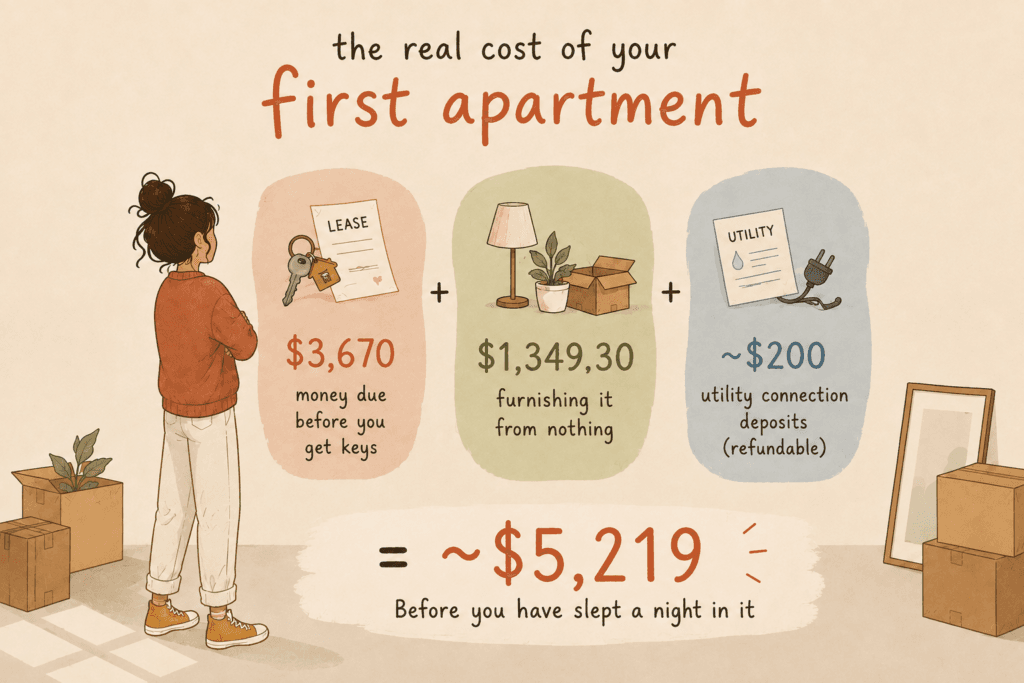
Now the uncomfortable part. The median renter household has $1,810 in cash savings, from Harvard’s tabulation of the Federal Reserve’s 2022 Survey of Consumer Finances.
So most people move in underfunded. Not because they are bad with money. Because the number is bigger than anyone tells them, and they find out in the leasing office.
I remember doing the sums in the car afterwards and getting a different answer than the one I had walked in with. Nobody had lied to me. I had just never seen the whole thing written down in one place, which is the entire reason this article exists! I gotchu.
The money due before you get keys
This is the bucket that ambushes people. Here is what the median renter actually paid, from Zillow’s 2025 housing trends survey:
| Charge | Who pays it | Median |
|---|---|---|
| Security deposit | 83% of renters | $795 |
| First month’s rent | 73% | your rent |
| Last month’s rent, too | 24% | your rent again |
| Application fee | 73% | $75 among those who paid one (and the typical renter applies twice) |
Read that last row again. Two applications is normal, so budget the fee twice. I paid three.
Your deposit is not a free-for-all, though, and this is the single most useful thing in this article. Most states cap it by law.
| Cap on your security deposit | States |
|---|---|
| 1 month’s rent | California, New York, Massachusetts, Maryland |
| 1.5 months | New Jersey, Arizona, Michigan |
| 2 months | Virginia |
| 3 months | Nevada |
| No state cap | Texas, Florida, Washington, Georgia, Illinois, Colorado |
Maryland is worth flagging. It dropped from two months to one for leases signed on or after 1 October 2024. Half the charts online still say two (including some big ones), so check the statute, not a blog.
Application fees are capped in places too. New York caps them at $20 (which is not a typo)! Maryland: anything over $25 must be refunded above actual costs. Connecticut, Virginia and New Mexico $50. California uses a 1998 base of $30 adjusted for inflation every year, about $69 in 2026, indexed annually. And Massachusetts does not let landlords charge one at all.
The part I did not know to ask about. Massachusetts landlords may legally collect exactly four things: first month, last month, a deposit capped at one month, and the cost of a new lock. Since August 2025 there is an optional fifth, a fee instead of a deposit, which has to be offered as a choice rather than a condition. That is it. Which sounds protective, and is, but it also means the legal maximum on day one is three months’ rent plus a lock. On a $1,962 apartment that is roughly $5,900 before you own a fork.
One more, if you are looking in New York City. The FARE Act took effect on 11 June 2025 and made it illegal for a landlord to pass their broker’s fee to you. StreetEasy measured the fee it killed at an average of $5,862. Total NYC move-in costs on fee listings averaged $12,951 before the Act (yes, really). Asking rents on broker-listed places rose about $46 a month afterwards, which is a trade I would take every time.
The 30-item first apartment checklist, priced
Every article you will read says it costs $3,000 to $8,000 to furnish an apartment. I went looking for where that number came from.
It came from furniture retailers and moving companies. Not one of them publishes a method. There is no government figure, no survey, no study. It is marketing, repeated until it sounded like a fact (which is how most money “facts” happen, honestly).
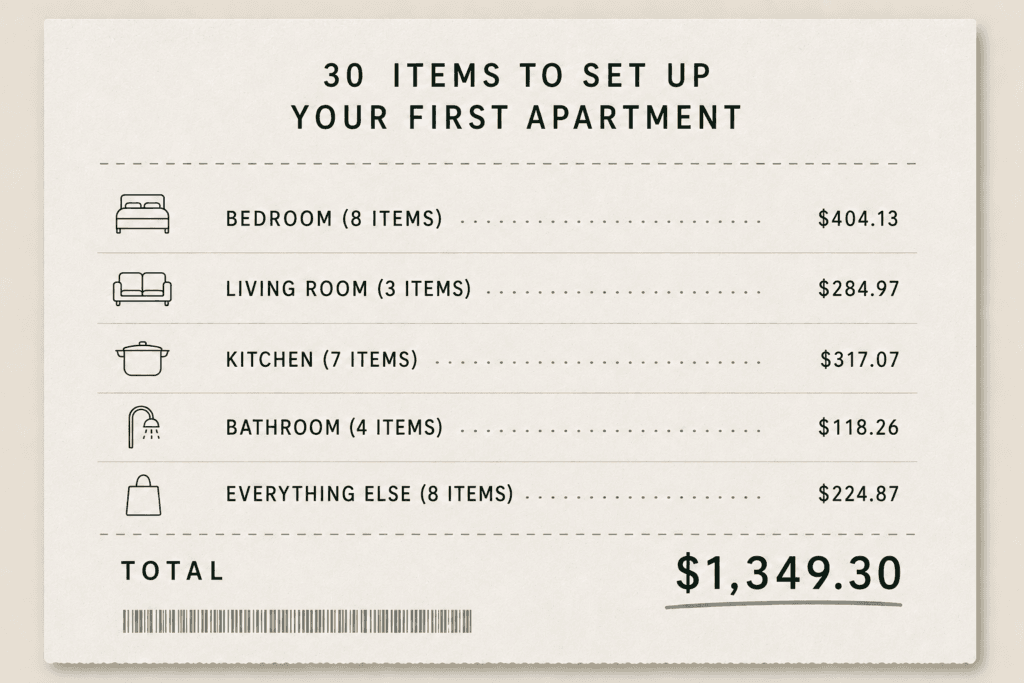
So I priced it instead. Thirty items, everything you need to live like a functional adult, nothing rated under 4.0 stars. Priced on Amazon on 24 August 2026.
Bedroom
| Item | Price |
|---|---|
| Queen metal platform bed frame | $51.99 |
| Queen 8 inch gel memory foam mattress | $169.99 |
| Sheet set, 6 piece | $29.74 |
| Comforter set, 3 piece | $36.99 |
| Pillows, 2 pack | $29.99 |
| Velvet hangers, 60 pack | $34.95 |
| Blackout curtains, 2 panels | $29.59 |
| Curtain rod | $20.89 |
| Bedroom total | $404.13 |
Living room
| Item | Price |
|---|---|
| Convertible futon sofa bed | $169.99 |
| Floor lamp | $44.99 |
| Small dining table and 2 chairs | $69.99 |
| Living room total | $284.97 |
Kitchen
| Item | Price |
|---|---|
| Nonstick cookware set, 15 piece | $75.98 |
| Stoneware dinnerware, 12 piece | $69.95 |
| Flatware, 40 piece | $32.99 |
| Chef knife set, 3 piece | $34.18 |
| Glass food storage, 24 piece | $39.99 |
| Dish drying rack | $25.99 |
| Kitchen trash can, 13 gallon | $37.99 |
| Kitchen total | $317.07 |
Bathroom
| Item | Price |
|---|---|
| Shower curtain, liner and hooks | $25.99 |
| Bath towel set, 6 piece | $38.29 |
| Toilet brush and plunger set | $35.99 |
| Shower caddy | $17.99 |
| Bathroom total | $118.26 |
Cleaning and everything else
| Item | Price |
|---|---|
| Compact upright vacuum | $59.93 |
| Broom and dustpan set | $18.83 |
| Laundry hamper | $31.97 |
| Cleaning supplies starter set | $24.81 |
| Household tool kit, 40 piece | $19.99 |
| First aid kit | $18.36 |
| Surge protectors, 2 pack | $26.99 |
| Fabric storage bins | $23.99 |
| Everything else total | $224.87 |
Every item above links to the exact product I priced, so you can check my working. Prices were correct on 24 August 2026 and will have moved since, which is fine: the link shows you today’s.
Thirty items. $1,349.30. Not $8,000. Not $3,000.
Prices move, so treat these as a starting point rather than gospel. But the shape holds: a whole apartment, furnished new, costs somewhere near $1,400 and not five figures.
You can go lower. Bed frames and sofas are the two things people give away constantly, and a free frame plus a new mattress cuts $50 off with zero downside. Buy the mattress new, though. Please. Used-bedding laws vary by state and mostly regulate dealers rather than private sellers, so a mattress off Marketplace comes with no sanitising guarantee. The EPA’s advice is to check any secondhand furniture for bed bugs before it comes through the door. Bed bugs are not a budgeting problem, they are a burn-your-things problem.
Heads up: the file is 12.8 MB, so give it a moment. It’s print-resolution, which is the whole point: it should look sharp when you actually print it, not pixelated. Two pages. The thirty items with a blank column for your own prices, and a move-in worksheet with the sixteen fees to get in writing before you sign. Free, no email needed.
What starts costing you the day you move in
The upfront money is a one time hit. This part is forever.
Renter households spend roughly $150 a month on electricity, gas and water, per the Bureau of Labor Statistics. Add roughly $75 for internet. Add $13 to $15 for renters insurance.
Call it $240 a month on top of rent, and note that the BLS figure covers households averaging 2.2 people. Alone in a one bedroom you will land under it.
Two things worth knowing here.
Utility companies may ask you for a deposit. Nobody warns you. It is usually one to two months of estimated usage, it is refundable with interest, though how long that takes is set state by state: North Carolina releases it after twelve consecutive on-time bills, Georgia makes you wait twenty-four. You can often avoid it entirely with a letter of credit reference from a previous utility or a guarantor. In North Carolina the cap is two twelfths of your estimated annual bill. In Georgia it is two and a half twelfths. Budget $100 to $300 per utility and be pleasantly surprised.
Renters insurance is the cheapest thing you will ever buy. Around $13 to $15 a month covers your possessions, your liability if you flood the unit below, and a hotel if the place becomes unlivable. Your landlord’s policy covers the building, not your stuff, which is the misconception that costs people the most.
One catch: jewellery is usually sublimited around $1,500. If you own anything above that, it needs scheduling separately.
You will read that “only 37% of renters have renters insurance.” That figure is from a poll conducted in 2014. The same pollster kept asking, and by 2020 it was 57%, the highest reading they had ever recorded, and nobody has published one since. So the honest version is that more than half of renters are covered, and the number everyone quotes is twelve years old. What is also true is that landlords increasingly require it in the lease.
Can you actually afford it? The maths nobody shows you
You have heard the 30% rule. Spend no more than 30% of your income on rent.
It is a real federal standard, not internet folklore. It started as the Brooke Amendment in 1969, capping rent at 25% of income in subsidised housing, and Congress raised it to 30% in 1981. But notice what it was written for. It was a ceiling for public housing, not budgeting advice for someone signing a market lease.
Now here is my favourite thing I found while writing this.
Landlords use a different rule: you must earn 40 times the monthly rent annually. Sounds stricter. It is not. It is the same rule wearing a different outfit. If income equals 40 times monthly rent, then rent divided by income is 12 over 40, which is exactly 30%.
And it checks out in the real world. Zillow says you need $78,488 a year to afford the typical US rental. Their median rent is $1,962. Multiply by 40 and you get $78,480. They agree to within eight dollars.
So what does that mean for an actual person?
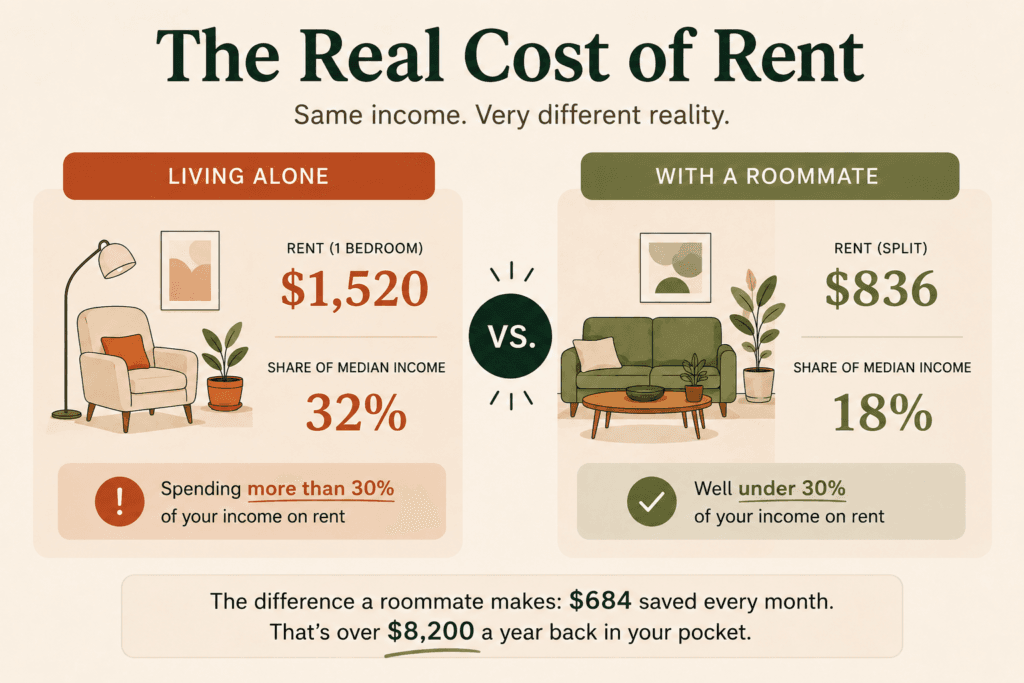
Median earnings for a woman aged 25 to 34 are $1,095 a week, per the Bureau of Labor Statistics for the second quarter of 2026. Work all fifty-two and that is $56,940 a year, or $4,745 a month. Thirty percent of that is $1,423.
The median one bedroom in July 2026 was $1,520 to $1,550.
She is short. By about $100 to $130 a month, on median earnings, for a median apartment. That is not a personal failing, it is arithmetic, and it explains why 49% of American renters spend more than 30% of their income on housing.
| Situation | Rent | Share of income |
|---|---|---|
| One bedroom, alone | $1,520 | 32% |
| Two bedroom, split with one roommate | $836 | 18% |
A two bedroom costs about $120 more than a one bedroom in ApartmentAdvisor’s numbers, and rather more in Zumper’s. Split two ways, that is the difference between failing every affordability test and passing all of them comfortably.
The roommate decision is worth more than every other money tactic in this article combined.
More than couponing. More than meal prep. More than any budgeting app. I know it is not the romantic answer. It is the true one.
How long you need to save
Take the total, divide by what you can move each month. That is genuinely all this is.
| Your target | Total | At $400/mo | At $600/mo |
|---|---|---|---|
| Lean: roommate, secondhand furniture | ~$2,800 | 7 months | 5 months |
| Median: alone, everything new | ~$7,000 | 18 months | 12 months |
| High cost city, alone | ~$9,700 | 24 months | 16 months |
Each of those totals is upfront costs, plus furnishing, plus utility deposits, plus one month of rent as a buffer. The buffer is not optional. Moving in with zero dollars left is how a broken laptop turns into a credit card balance.
So: start twelve months out if you are moving alone, six with a roommate.
If that feels far away, it is the same shape as any other savings goal, and I have written about the mechanics elsewhere. The savings challenge matched to your paycheck works well here because the target is fixed and the deadline is real. If your number is closer to $1,000 than $5,000, saving $1,000 in three months is the faster version.
Keep it somewhere separate from your spending money. Not because you lack willpower, but because a moving fund sitting in checking stops feeling like a moving fund and starts feeling like money (I have spent mine, twice, and could not tell you now what on). Where to keep it covers the three things to check before opening an account.
If I am honest about what changed things for me, it was seeing the money leave rather than trying to remember it had. A separate account does that. So does an app that categorises the spending for you, and I compared the main ones in the budgeting apps guide if you want the shortlist rather than the whole aisle. Either works. Doing neither is what I did for about four years, and I do not recommend it.
Worth trying. Save the deposit first, on its own, before anything else. It is the single biggest line item, it is refundable, and hitting it early makes the rest feel like shopping rather than survival.
The fees nobody puts in the listing
You will see “junk fees” mentioned everywhere in 2026. Here is the correction.
The federal rule that took effect on 12 May 2025 covers live event tickets and short term lodging only. It does not cover rental housing. A rental housing version is at the advance notice stage, published in March 2026, which means it is a question the government is asking, not a rule anyone has to follow.
So do not assume you are protected. Almost three quarters of recent renters, 74%, report paying at least one mandatory fee on top of rent.
Ask for the itemised list before you sign. The ones to look for: amenity fee, lifestyle fee, technology fee, valet trash, package locker, pest control, parking, administrative fee, move-in fee, online payment “convenience” fee, and pet rent (which is monthly, forever, and separate from the pet deposit).
Some states now force disclosure. Colorado since January 2026, Massachusetts since September 2025, and Virginia, which has required it since 2024 and tightened the rules in July 2025. Connecticut has passed its own version. New York City requires it under the FARE Act. Everywhere else, you have to ask.
Then there is the deposit coming back, which is its own quiet trap.
Photograph everything on day one. Timestamped, every room, every scuff, inside the appliances. Do it again the day you hand back the keys. It takes fifteen minutes and it is the only evidence that exists. Colorado’s new law even forces landlords to hand over their photos and receipts within fourteen days if you ask in writing, for tenancies ending on or after 1 January 2026, and several states have similar rules, but none of that helps if you never took your own.
Skip the deposit alternative products if you can. The ones charging $4 to $65 a month (depending on the provider) instead of a deposit insure your landlord, not you, whatever they are called. If there is damage, the company pays your landlord and then comes after you for it, and none of the fees you have already paid count toward what they claim. You pay a nonrefundable fee, you stay liable, and you give up the state deposit protections you would otherwise have had. It solves a cash flow problem at a genuinely bad price.
Questions I get asked
How much should I have saved before I start apartment hunting?
A renter facing all the standard upfront charges at median levels needs about $3,670 in cash. Have the furnishing money identified but not necessarily saved, because you can buy that over the first two months.
Is it cheaper to get a studio or a one bedroom?
Nationally in July 2026 the studio was actually more expensive, $1,595 against $1,550, which surprises everyone (ApartmentAdvisor). It is a location effect rather than a pricing one, because studios cluster in expensive dense cities. In your city, check both.
What is the one thing people forget?
The second application fee. And the shower curtain, but mostly the second application fee.
Can I negotiate any of this?
Sometimes. Just under 40% of listings offered a concession in July 2026, 39.8% by Zillow’s count, usually a month free. Ask what they can do on move-in costs specifically, because a landlord who will not drop the rent will often waive an admin fee or split the deposit across two months.
The actual answer
About $5,200, and roughly a year of saving if you are doing it alone.
That is a bigger number than the internet told you, and I would rather you be annoyed at me now than surprised in a leasing office. Every figure above is sourced and dated, which means you can go check them, and you should.
Print the checklist, write your own city’s prices next to mine, and you will have your number instead of the national one. Yours is the only one that matters.
This post may contain affiliate links. See my disclosure.
Sources
Move-in costs and renter savings. Alexander Hermann and Elizabeth R. Jones, From Deposits to Fees, Renters Struggle with Up-Front Costs, Harvard Joint Center for Housing Studies, 16 March 2026. The $1,810 savings figure is the Center’s tabulation of the Federal Reserve Survey of Consumer Finances, 2022. Deposit, application fee and multiple-application data from Renters: Results from the Zillow Consumer Housing Trends Report 2025, 27 October 2025.
Rents and affordability. Zillow’s July 2026 rent report for the $1,962 typical asking rent, the $78,488 income requirement and the 39.8% concession rate. Bedroom-level medians from Zumper and ApartmentAdvisor, July 2026, with Apartment List and CoStar for comparison. Cost burden from America’s Rental Housing 2026, Harvard JCHS.
Deposit caps, by statute. California Civil Code 1950.5 · New York General Obligations Law 7-108 · Massachusetts M.G.L. c.186 s.15B · Maryland Real Property 8-203, amended by HB 693 (2024) · New Jersey 46:8-21.2 · Arizona 33-1321 · Michigan MCL 554.602 · Virginia 55.1-1226 · Nevada NRS 118A.242. Colorado has no statutory cap; Colorado Legal Help.
Application fees. New York Real Property Law 238-a · Maryland Real Property 8-213 · Connecticut 47a-4d · Virginia 55.1-1203 · New Mexico SB 267 (2025) · California Civil Code 1950.6, current amount published by the Berkeley Rent Board · Massachusetts Attorney General’s Guide to Landlord and Tenant Rights.
New York City broker fees. NYC Department of Consumer and Worker Protection on the FARE Act, 11 June 2025. Fee and rent effects from StreetEasy, December 2024 and June 2026.
Rental fees. FTC Rule on Unfair or Deceptive Fees, effective 12 May 2025, and the FTC advance notice of proposed rulemaking on rental housing fees, 91 FR 12325, 13 March 2026. Disclosure laws: Colorado HB25-1090 · Massachusetts 940 CMR 38.00 · Virginia 55.1-1204.1. Deposit documentation: C.R.S. 38-12-103(8). Deposit alternatives: National Consumer Law Center, Tenant Insecurity, May 2026.
Utilities, insurance and income. BLS Consumer Expenditure Survey, housing tenure table · North Carolina Utilities Commission Rule R12-4 · Georgia Public Service Commission · Insurance Information Institute, renters insurance facts and coverage limits · BLS Usual Weekly Earnings, second quarter 2026.
The 30% rule. Congressional Research Service, Introduction to Public Housing, and HUD PD&R, Rental Burdens: Rethinking Affordability Measures, on the Brooke Amendment of 1969 and the 1981 increase to 30%.
Item prices. Amazon, checked 24 August 2026. Every item links to the exact product priced.
