
The Best Budgeting Apps of 2026, Matched to Your Money Personality
There is no best budgeting app. There is only the one you will still open in a month. Here are four, what each costs, and who each is for.
You downloaded a budgeting app once. You lasted about four days.
Then it asked you to file a $5 coffee into its own little category. And one quiet evening you just stopped opening it. Deleted it a few weeks later. Felt vaguely guilty about it. Decided somewhere in the back of your mind that you’re bad with money.
You’re not. The app was wrong for you. That’s a completely different problem, and it has a completely different fix.
Here’s the part nobody says out loud. A budgeting app is a personality match, not a leaderboard.
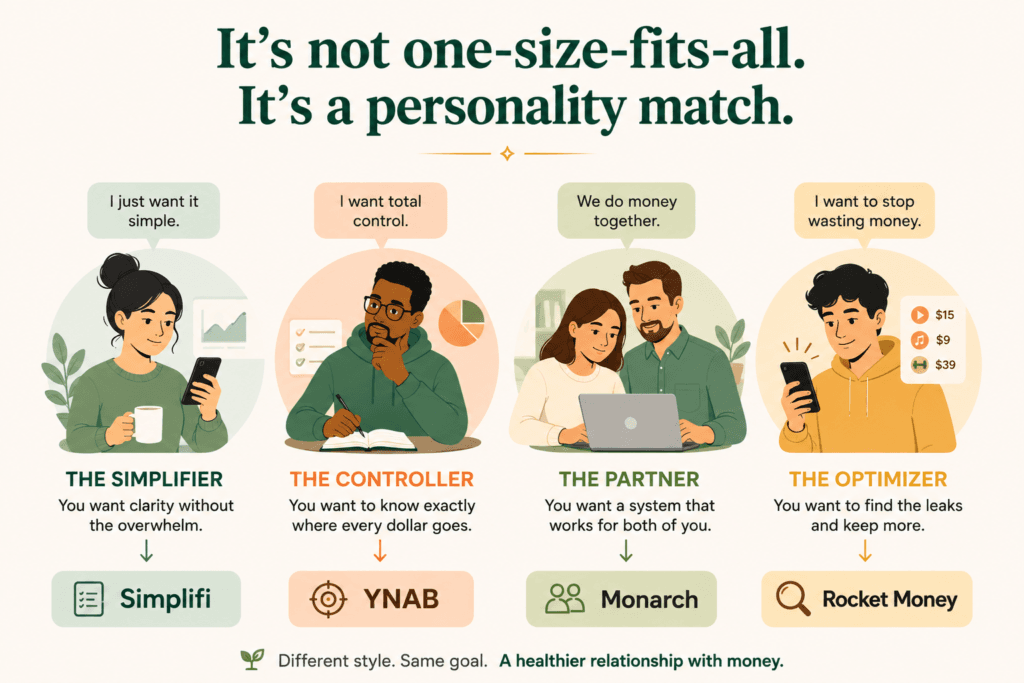
The woman who loves gripping every single dollar and the woman whose chest tightens at a spending chart need opposite tools. Hand them both the same “#1 pick” and one of them quietly thrives. The other quietly rage-quits. (I was the second one. Twice.)
And that’s my problem with every “top 10 budgeting apps” list I’ve ever read. They crown one winner. Then they leave you to work out on your own that you’re not the winner’s type.
So I’m not doing that. I picked the four I think are genuinely worth paying for in 2026, and I matched each one to the kind of person it’s built for. Find yourself below and your app is sitting right next to you.
Prices first. Because that’s what you came for.
What the four actually cost in 2026
| App | 2026 price | Free trial | Auto bank sync |
|---|---|---|---|
| Quicken Simplifi | $47.88/yr promo ($3.99/mo billed annually), renews higher | None, 30-day money-back | Yes, incl. investments |
| YNAB | $109/yr or $14.99/mo | 34 days, no card | Yes, via Plaid |
| Monarch Money | $99.99/yr Core ($199/yr Plus) | 7 days, card required | Yes, via Plaid/Finicity |
| Rocket Money | Free tier; Premium $7-14/mo | Free tier never expires; 7-day Premium trial | Yes, via Plaid |
That’s the whole money question answered. Now the part that actually decides it.
If money apps exhaust you: Quicken Simplifi
This is you if the word “categorize” makes you tired. If spreadsheets make you a little sleepy (real). If you don’t want a second job (who does).
You want one honest number. Can I get dinner tonight or not. That’s it. That’s the whole ask.
Almost nobody builds for that, which I find strange, because it’s the most common way people actually feel about money. Simplifi builds for exactly it.
Its entire personality is one calm question. What can I safely spend today? One number. No envelopes. No little categories to feed every night like a tamagotchi.
And if you’ve bounced off “real” budgeting before, I think that one number is the whole magic. Because it gives you permission and peace in the same breath. It’s also the cheapest of the four, and it tracks your investments while it’s at it. (A freebie nobody asked for. I’ll take it.)
This is the one I’d hand a friend who has tried and quit. Not because it’s the most powerful. Because it asks the least of her.
One thing so you’re not confused later. Simplifi is Quicken’s web and mobile app. It is not Quicken Classic, the old desktop software. If you want a program that lives on your computer, that’s Classic. Simplifi lives on your phone. Which is what most beginners actually want anyway.
One thing worth being straight about: there’s no free trial. Just a 30-day money-back guarantee, so you’re paying for a year up front. And the promo price quietly climbs to the standard rate at renewal if you’re not watching (sneaky). Set one calendar reminder for renewal day and you’ve beaten the only real trap this app has.
$47.88/year promo ($3.99/mo billed annually), renews higher · No free trial, 30-day money-back guarantee · Web and mobile, no desktop app
If you want to run the show: YNAB
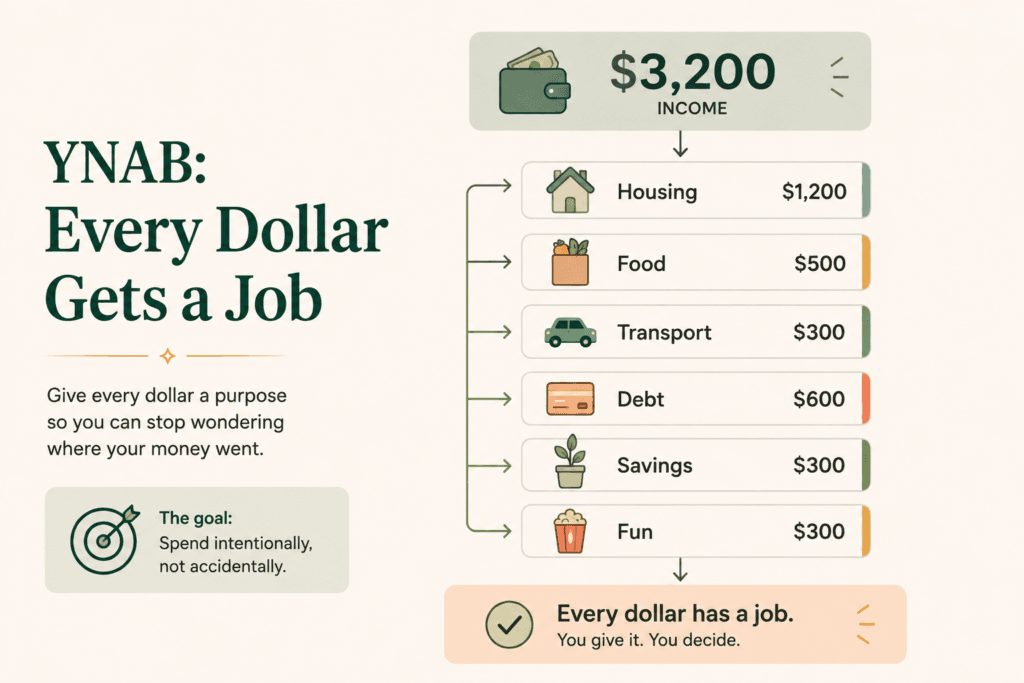
This is you if you secretly like being in charge (a little guilty about it, but yes). If you’re pleasantly intense about your goals (affectionately). If two minutes a day is fine as long as you can see the progress.
Especially if you’re clawing out of debt and you want your hands on the wheel.
YNAB feels like it was built inside your brain. Every dollar gets a job before it leaves your account. That’s the whole method.
Which turns budgeting from “well, that’s where it all went” into “here’s the plan, right now.” And for a controller, that shift is a little addictive. (Budgeting, addictive. Apparently so.)
It’s also the app I see people credit most often with actually paying down real debt. Not watching it sit there. Paying it down.
I’ll be straight with you though. I’m not this person, and I know it. The daily upkeep that a controller finds satisfying is the exact thing that made me quit budgeting apps twice. If that’s you too, skip to the next one. If it isn’t, this is probably your app and I’d stop reading here.
Here’s what I’d tell you in person: YNAB will not let you ghost it. Skip a few days and it gently pesters you to catch up (rude, but fair). If you’re not the hands-on type, that nudging is a real dealbreaker and you will come to resent it. But if this section is describing you, that structure is exactly the thing that keeps you honest. Fair warning though. It’s the priciest of the four, with no free tier. Just the longest trial.
$109/year or $14.99/month · One subscription covers up to 6 people · iOS, Android, Web, Apple Watch
If money isn’t a solo sport: Monarch Money
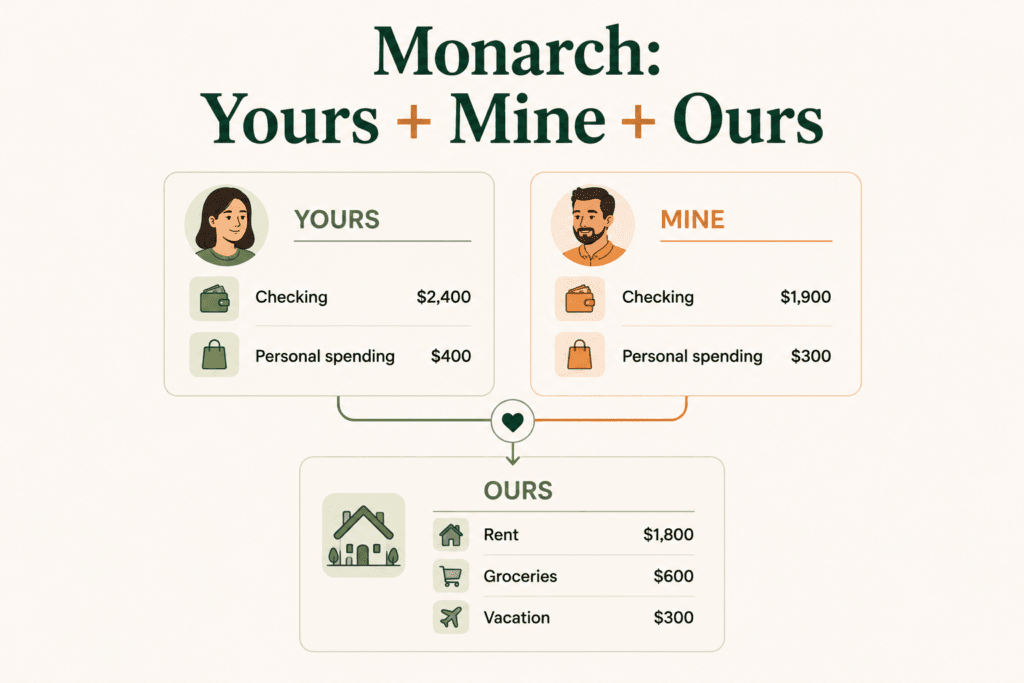
This is you if there’s a partner. A shared life. Some joint bills. The occasional family trip.
And that one loaded question you keep circling. How do we both see the whole picture without shoving every purchase into one big joint pile and starting a Tuesday night argument about it. (We have all had that argument.)
Monarch understands couples in a way the others don’t even attempt.
Its best trick is “yours, mine, ours” labelling. Two people, shared and separate money, one clean place. No forced merging. No interrogation over a single $30 charge. (You know the exact one.)
Add a household dashboard with net worth and investments, and it feels built for two from the ground up. Not bolted together afterwards. One subscription covers the household, with none of that “upgrade to the couples plan” nonsense.
The bit to check before you pay: if you bank with a smaller credit union or a regional bank, watch the syncing. The little institutions are the ones most likely to drop the connection (annoying, but better to know now). And to be completely real with you, if you’re single with one checking account, this is far more app than you will ever touch. Save your money.
$99.99/year Core ($199/year Plus) · Household sharing for you and a partner · iOS, Android, Web
If you’re leaking money slowly: Rocket Money
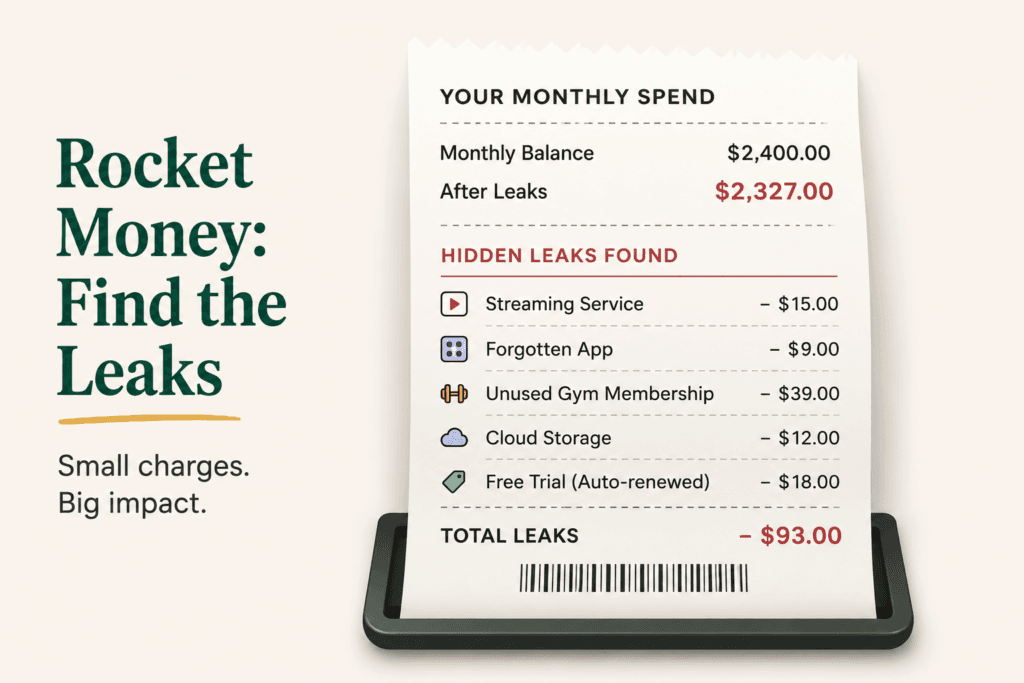
This is you if you’re not blowing the budget at restaurants. You’re bleeding, slowly.
A “free” trial that quietly started charging you (classic). A streaming service you forgot you had (be honest). An app you opened once in 2024 and never again (rip).
You don’t need a budgeting philosophy. You need to find the leaks and plug them.
Rocket Money is weirdly satisfying for exactly this. You link your accounts. It goes hunting for every recurring charge. Then it serves you that small gut-punch of “wait, I’m STILL paying for that?” (The betrayal is real. I have felt it.)
And the free tier does all of that without costing you anything. Which, for a leaker, I’d bet saves more than any paid app would.
If I were starting over with none of these, I’d start here. Not because it’s the best budgeting app. Because it takes about ten minutes to find out whether you have a leak, and you find out for free.
Read this part slowly: it’s a subscription-finder with light budgeting stapled on. As an actual budgeting tool it’s thin, and the free plan limits you to two categories. The one-tap “cancel it for me” button lives behind Premium. So does bill negotiation, and that negotiation takes 35-60% of your first-year savings as its cut. Read the fine print on that one. It’s also owned by Rocket Companies, which is worth knowing if you care who holds your financial data.
Free tier · Premium $7-14/month (pay-what-you-want) · iOS, Android, Web
Still not sure which one is you?
Find the line that sounds most like you.
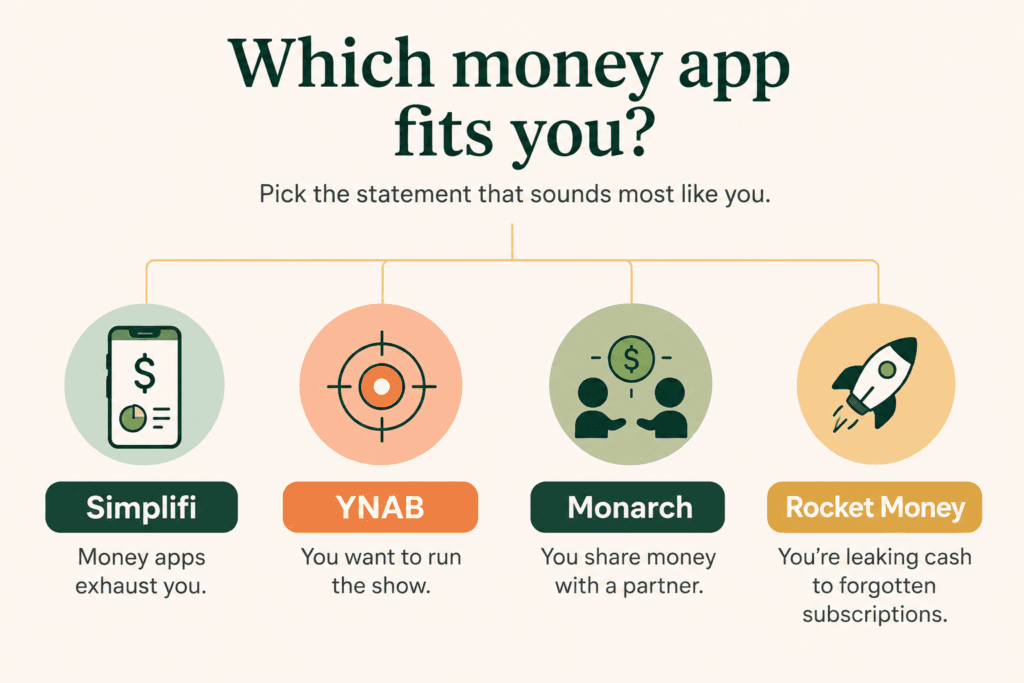
Most of us are a blend. But one type usually runs the show, and I’d trust whichever section made you nod.
And if you truly can’t tell which is you? Start as the Avoider. Simplifi is cheap, and the 30-day money-back guarantee means trying it costs you a few minutes and nothing else. That’s the advice I’d give my sister.
Before you pay for anything though, I’d want you to know what you’re actually working with each month. That’s what the free budget template is for.
Budgeting app questions people actually ask
Is a paid budgeting app worth it when free ones exist?
Only if you’ll open it. A $109 app you use beats a free one you deleted. But start free if you’re unsure. Rocket Money’s free tier costs nothing and will tell you within a week whether you’re the kind of person who checks.
Can I just use a spreadsheet instead?
Yes, and plenty of people do it beautifully. The catch is that a spreadsheet needs you to enter everything by hand. If manual entry is the reason your last three attempts died, an app that syncs is solving your actual problem. If you like the entering, the spreadsheet is free and it works.
Is it safe to link my bank to these?
All four connect through Plaid or Finicity, which are read-only connections. They can see your transactions, not move your money. That said, look at who owns the app. Rocket Money belongs to Rocket Companies, and if that matters to you, it’s better to know before you link than after.
What if I pick wrong?
Then you’ve learned something for the price of a trial. YNAB gives you 34 days without a card. Simplifi gives you 30 days to get your money back. Neither of those is a trap, and picking wrong once is not evidence of anything about you.
The only rule that’s ever mattered
Pick the one that matches the section you recognised yourself in. Not the one with the best review score.
I know that’s less satisfying than being handed a winner. But I’ve watched too many people pay for the “best” app and quit it in a fortnight, and I’d rather you kept your $109.
Because the best app was never the fanciest one.
It’s the one you’ll still bother to open a month from now.
Pricing verified against each provider’s official site; promo rates change often, so confirm current pricing before subscribing. This post may contain affiliate links, which means I may earn a small commission if you sign up through them, at no extra cost to you. I only point you toward tools I think are worth it.