
Where to Keep Your Savings Challenge Money
I did the hard part, and then handed the reward to an account that was never built to hold it.
I finished my first real savings challenge and felt proud of myself for about a week. Then I looked at where my savings challenge money had been landing the whole time. Same checking account I use for groceries and rent, same debit card in my wallet, earning something so close to nothing I’m mildly embarrassed to have gone three months without checking.
Why I never moved it
The honest answer isn’t that I didn’t know better. I did know better, in the vague way you know you should floss more. The real reason was smaller and dumber than that: opening a new account felt like a chore I could always do next week, and next week never has a savings challenge finishing in it, so there was never a natural moment to do it. The money just kept landing somewhere convenient instead of somewhere good.
If that sounds familiar, this is the part nobody puts on the pretty printable, so here it is. Where you keep your savings challenge money matters almost as much as how you saved it.
What the gap actually costs you
The FDIC publishes the national average savings rate every month, and as of July 2026 it sat at 0.38 percent. That’s the average across ordinary savings accounts, including the big-name bank most people default to because it’s the one their parents used. On a completed challenge of a few hundred or a thousand dollars, 0.38 percent works out to pocket change over an entire year. Sometimes literally less than five dollars. Online-only savings accounts routinely pay several times that, sometimes ten times over, and it isn’t a trick. A bank with no physical branches has a fraction of the overhead of one with tellers and buildings on every corner, and a meaningful chunk of what it saves gets passed to you instead of the lobby. I won’t quote you a specific number here, because whatever figure I typed today would be stale within a few weeks. Check the provider’s own page for their current rate, not a comparison blog, not a “best of” list from eighteen months ago. The bank’s own site is the only number that’s current.
Before you open anything, check these three
- FDIC insurance. Coverage is $250,000 per depositor, per insured bank, for each account ownership category, comfortably more than a savings challenge will ever produce, but it’s the one thing separating a real savings account from something that only resembles one. Look for the badge on the provider’s own site.
- No monthly fee, and none that appears only if you dip below a minimum balance. An account that charges you to hold your own money defeats the point, and some hide this behind a “waived if you maintain $X” clause that quietly stops applying the first month you need to draw the balance down.
- Enough friction that you won’t raid it on a Tuesday. Counterintuitive, I know, but hear me out below.
The friction is the feature
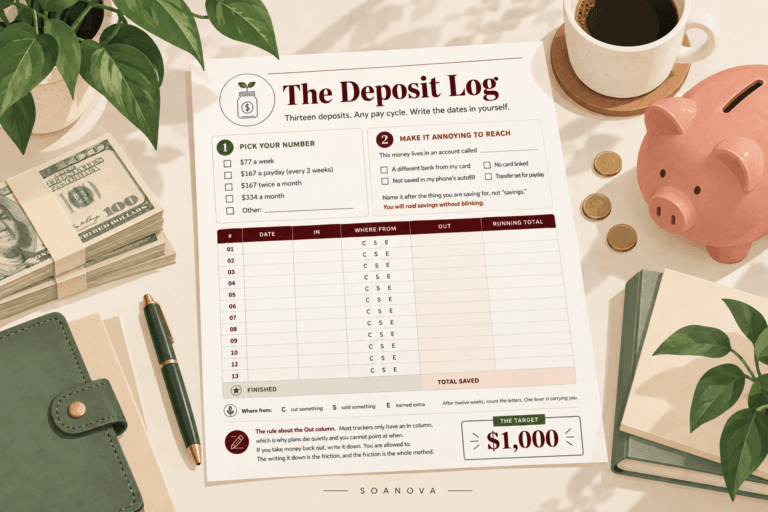
When I wrote about saving my first thousand dollars in three months, I admitted I nearly pulled forty dollars back out around week seven for a night out. The only reason I didn’t was that the account lived at a separate bank with no debit card attached, so getting the money back out meant a deliberate transfer, not a tap. Instant access sounds convenient right up until convenience is the thing working against you.
Here’s what I’d tell you if we were talking in person: I made the opposite mistake once, with a different account, and picked one where transfers back to checking took three full business days. Fine for a savings challenge. Genuinely bad for the part of your savings that’s supposed to be an actual emergency fund, where a burst pipe or a missed paycheck doesn’t wait three days. Keep challenge money and emergency money in the same place, and the friction protecting one can quietly work against the other. Worth thinking about which one this specific account is really for.
One account, or several
If you’re running a challenge from the main guide or the 52-week version, you don’t need a separate account for every goal on day one. What your savings challenge money needs is separation from spending, full stop. A single high-yield account with clear internal notes, or your bank’s own sub-account feature if it has one, does the job. Multiple accounts start to matter once you’re running several goals at once, a challenge alongside an actual emergency fund alongside a holiday sinking fund, and want to see each number without doing mental math every time you check the balance.
Haven’t worked out how big your emergency fund specifically needs to be? That’s a separate question from a savings challenge, and I’ve written about what a realistic target looks like so the two goals don’t get tangled into one undifferentiated pile of money.
A few questions worth answering before you open anything
My bank is well known, isn’t that enough? Brand recognition and FDIC coverage aren’t the same thing. Most major banks are insured, but check for the badge directly rather than assuming, and don’t confuse “I’ve heard of them” with “I confirmed it.”
Should I just use my bank’s built-in savings feature instead of opening something new? If it pays a genuinely competitive rate and has no fees, sure, that’s one less account to manage. Check the actual rate against a few online-only options first. A lot of built-in “savings” tabs still pay close to the 0.38 percent national average.
Is this the same thing as my emergency fund? Not automatically. They can live in similar accounts, but they’re answering different questions: a challenge is a goal with a finish line, an emergency fund is meant to sit untouched indefinitely. Worth deciding on purpose rather than by accident.
Getting started
Open the account before you finish your next challenge, not after, so your savings challenge money has somewhere real to land from day one instead of sitting in checking while you mean to get around to it. Confirm the FDIC badge, confirm there’s no fee waiting to appear, check the actual current rate on the provider’s own page.
I still think about that first challenge sometimes, proud for a week, then quietly annoyed at myself for three months of near-zero interest. The savings part was never the hard part. Giving it somewhere real to land was.
This post may contain affiliate links. See my disclosure. Educational content only, not financial advice.