

The 90-Day Debt Payoff Plan for When You Feel Stuck
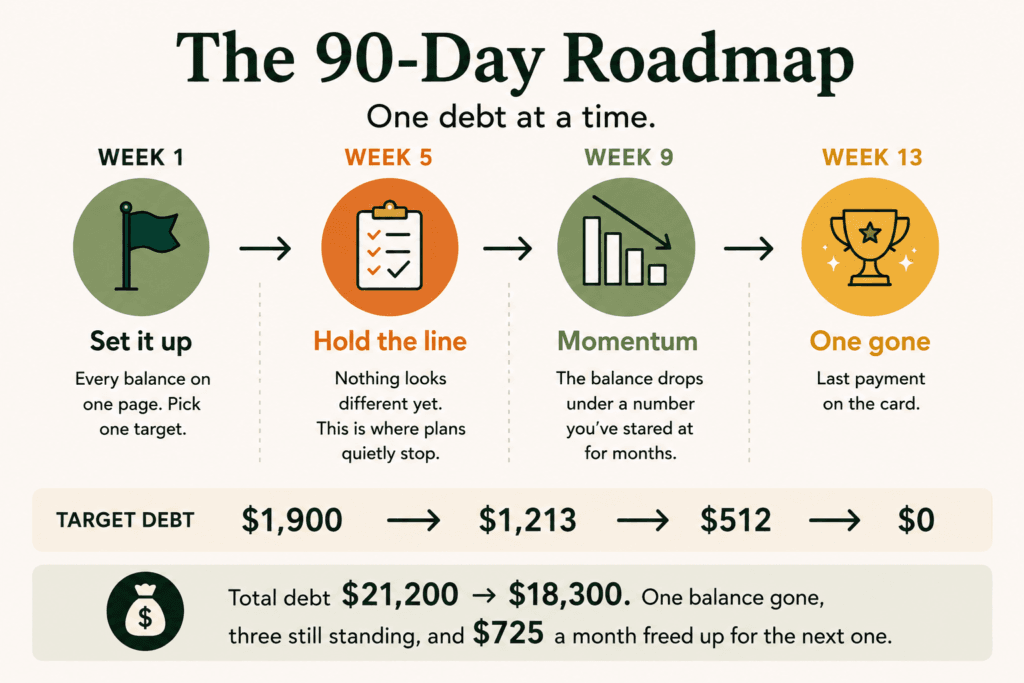
Most debt payoff plans don’t fail because the math was wrong. They fail around week five. Nothing has visibly changed yet, so you stop checking the balance. Then you stop opening the email from the bank. Then you start flinching a little every time their name shows up in your inbox (which is its own problem, and no spreadsheet warns you about that one).
I know week five well. My first attempt at this was a color-coded spreadsheet with four tabs. One of them was a chart. I abandoned the whole thing before I made a single extra payment. The spreadsheet was beautiful. My balances were exactly what they had been the day I built it.
So this isn’t about which method is mathematically optimal. I’ve written about that fight already, and the research is clearer than you’d expect. This is about the ninety days after you pick one. How to build them so you’re still standing in month three.
There’s a free two-page worksheet further down, at the end of step four. Page one is your balances. Page two is the thirteen boxes. No email needed.
Why a debt payoff plan should run ninety days, not a year
Because a year is long enough to forget you started. Ninety days is one season. You can hold it in your head. You can see the end of it from the beginning. And the person who commits in week one is still recognizably the person who finishes in week thirteen.
A ninety-day plan won’t clear most people’s debt, and I’m not going to pretend otherwise. What it will do is get one balance gone. It proves the system works. It leaves you with a habit that runs without supervision. That’s the real deliverable. The money is almost a side effect.
Step 1: Put the whole number on one page
Every balance, every rate, every minimum, in one place. Not in an app. Not spread across four tabs (see above). And definitely not in your head, where it has been quietly compounding into something much worse than it is.
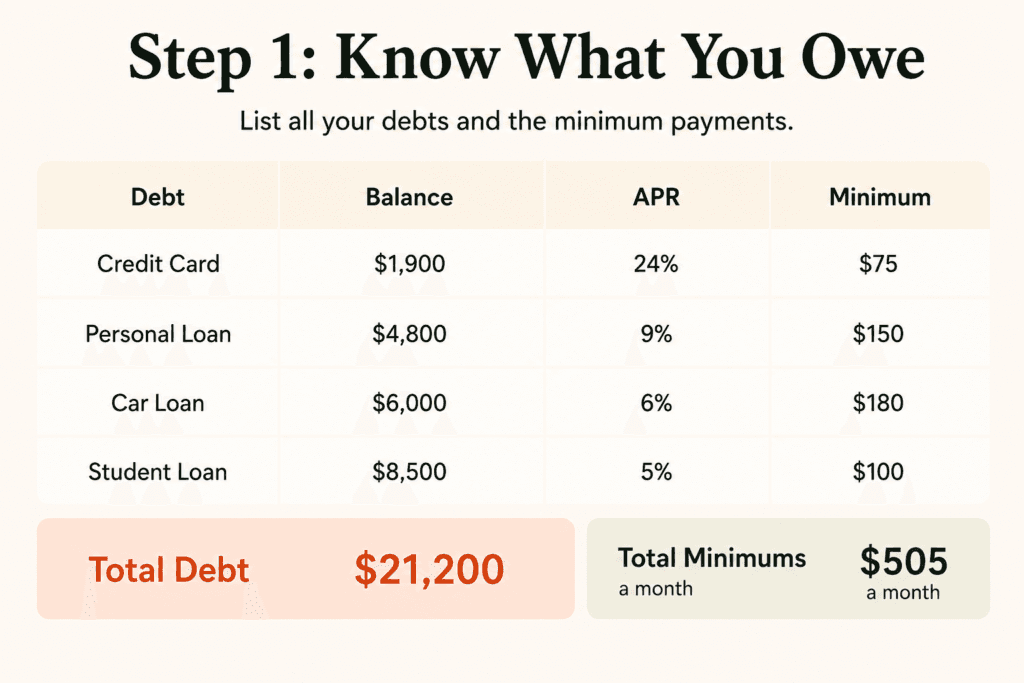
People skip this step, and not because they’re lazy. Adding it up makes it real, and there’s a specific dread in seeing the total for the first time. I’d still make you do it. A number you’re avoiding grows in your imagination faster than it grows on the statement. Mine came out about four hundred dollars lower than the figure I’d been carrying around for a year and a half. A year and a half of low-grade dread, over four hundred dollars that didn’t exist.
While you’re there, write the interest rate next to each one. Most people know their balances roughly and their rates not at all (be honest). The rate is what decides the order in step two.
Step 2: Pick your one target
Minimums on everything, always, no exceptions. Then every spare dollar goes at exactly one debt.
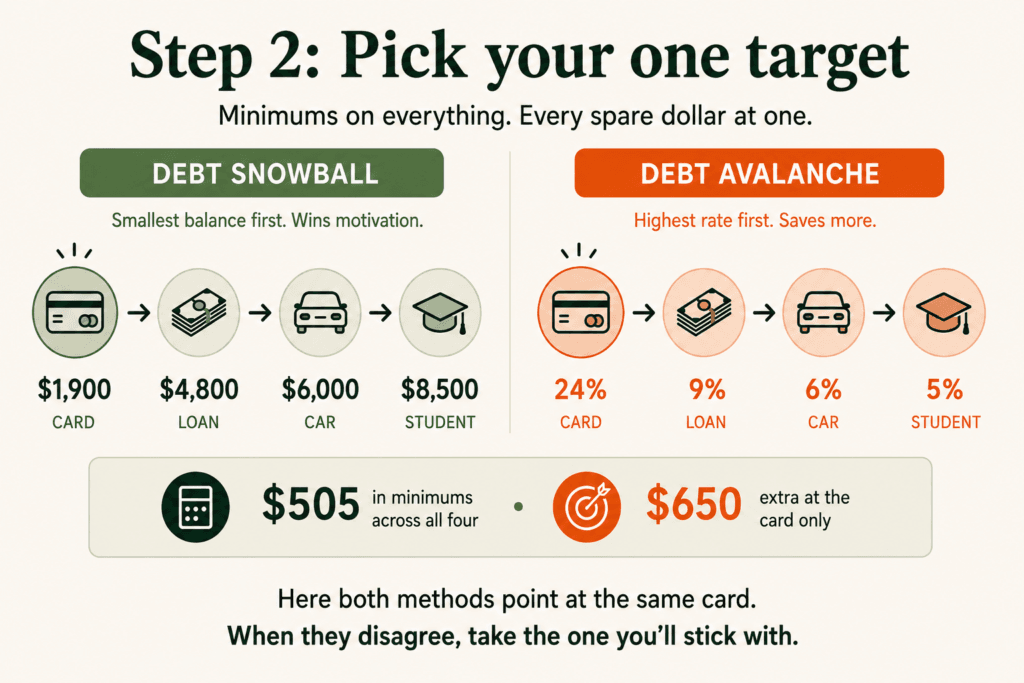
Which one depends on you, not on a rule. If you’ve stalled before, take the smallest balance and kill it. A debt that is completely gone does something for your motivation that a slightly-less-enormous big balance never will. If you’ve got one large balance sitting at a much higher rate than the rest, take that one, and take it seriously. The interest gap is real money. If you’re torn, the full comparison, with the behavioral research behind it, is worth ten minutes.
Pick today. Not after more research (I once read about debt payoff methods for three weeks, which is three weeks of interest I paid for the privilege of being well-informed). The cost of picking the slightly wrong one is measured in tens of dollars. The cost of not picking is measured in months.
Step 3: Find the payment, on paper first
Here’s the arithmetic, because a plan without a number is a wish.
| If you can find | Over 90 days that’s | Which clears |
|---|---|---|
| $25 a week | $325 | A small store card, usually |
| $50 a week | $650 | Most single small balances |
| $100 a week | $1,300 | A real dent in a real card balance |
| $150 a week | $1,950 | Often an entire mid-size debt |
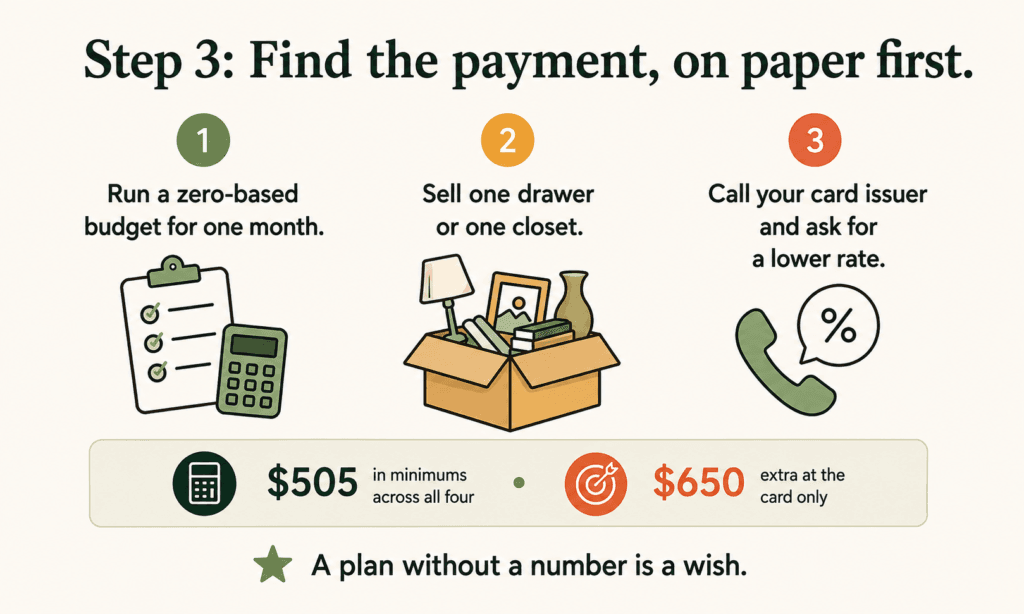
Pick your row before you go looking for the money, so you know what you’re aiming at. The only method I’ve found that reliably surfaces the extra payment is running a zero-based budget for one month. It forces every dollar to declare itself, and the leaks turn up on their own. Usually a subscription you forgot about, and a food delivery habit you’d been describing to yourself as “occasionally.”
Two other levers, both underrated. Sell one drawer or one closet on a marketplace app. It raises more than people expect, and it’s a lot faster than earning the same amount at work. Then call your card issuer and ask for a lower rate. One phone call. It works more often than you’d think if your payment history is decent, and the worst possible outcome is a stranger saying no to you on the phone (which you will survive).
Quick tip: set the payment to leave your account the day after payday, not a date you picked because it looked tidy on the calendar. Money still sitting there on day three has a remarkable talent for finding other jobs.
Step 4: Make the progress visible somewhere you’ll see it
This is the step that separates a plan you finish from a plan you abandon, and it’s the one most debt advice skips entirely.
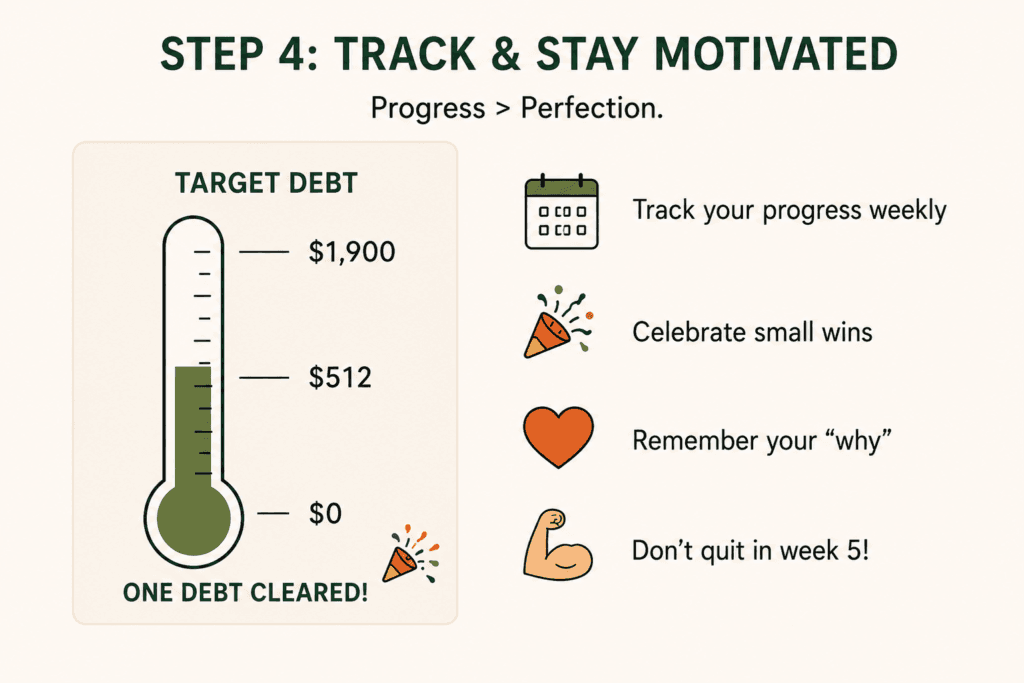
Debt payoff has a design flaw baked into it. The reward is invisible. Saving gives you a number that goes up, which is quietly delicious to look at. Paying off debt gives you a number that goes down toward zero. Same progress. Feels like nothing, because you aren’t gaining anything. You’re just becoming less behind.
Nobody throws a party for less behind.
So build the feedback yourself. Thirteen boxes on a sticky note, one per week, coloured in when the payment clears. A number on the fridge, crossed out and rewritten each month. Whatever you’ll physically see without having to decide to look at it. It sounds like something you’d give a seven-year-old for brushing their teeth. It works, which is roughly the pattern for everything that works.
This is the same mechanism doing the heavy lifting in the savings challenges people start every January. The grid isn’t the point. Watching the grid fill up is the point.
Two pages, and it’s a small file so it opens straight away. Page one is every balance, rate and minimum in one place, with a total at the bottom and room to name the debt you’re killing first. Page two is the thirteen weeks, one box each, with space for the date, the payment and the balance after. Print it, stick it somewhere you can’t avoid looking at it. Free, no email needed.
Step 5: Put a small cushion in front of it
Before you throw everything at the balance, park somewhere between $500 and $1,000 where you can reach it.
The reasoning here is mechanical, not emotional. Without a cushion, the first unexpected car repair goes straight back onto the card you just paid down. Three months of sprinting, to arrive exactly where you started. I’ve done two full laps of that track. Both times I concluded I was simply bad with money. I was not bad with money. I was missing six hundred dollars. If you don’t have that yet, here’s how much you realistically need, and here’s how to build it in roughly the same ninety days.
Yes, that means the debt waits a little. It waits considerably less than it would if you had to start over.
The part I’d want a friend to know. The reason this is urgent rather than merely sensible is what a carried balance costs right now. Federal Reserve data put the average rate on credit card accounts assessed interest at 22.15 percent in the second quarter of 2026, against 20.94 percent averaged across all accounts.
That second number is the one on the advertisement. The first is what you pay for the crime of carrying a balance. On $3,000 that’s roughly $55 a month going out the door and buying you absolutely nothing. Clearing a card at 22 percent is a guaranteed 22 percent return, and no index fund on earth will promise you that with a straight face.
What the ninety days actually feel like
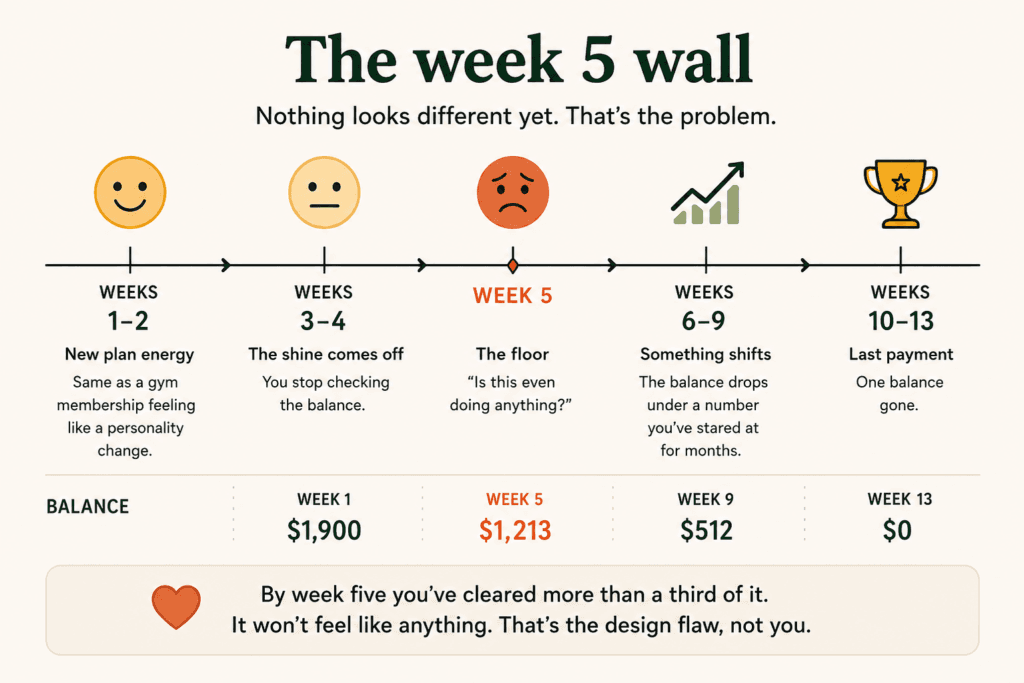
Weeks one and two feel great, because new plans always do. Same energy as a gym membership feeling like a personality change. Weeks three to six are where it dies, if it’s going to, and that is precisely what step four is for. Somewhere around week eight the balance drops below a round number you’ve been staring at for months, and something shifts in a way I can only describe as smug. Week thirteen you make the last payment. In my experience it feels weirdly small in the moment, and much bigger about a week later, usually while you’re doing something unrelated like brushing your teeth.
Then you do the one thing that turns this into a habit rather than an anecdote. Take the payment you were making and move the whole amount onto the next debt. Immediately, before your spending quietly expands to fill the space. It will try. Spending is very good at this.
Start today, not Monday
One page with every balance and rate on it. One target picked. One row from the table above, with the transfer automated for the day after payday. One visible tracker somewhere you can’t ignore it. One small cushion in place first.
That’s about forty minutes of work and one uncomfortable act of addition, which is the hardest part of the whole plan. The spreadsheet with four tabs is optional. Mine is still saved somewhere, beautiful and completely useless, a monument to the difference between planning to pay off debt and paying off debt.