How to Build Your First Emergency Fund (When Saving Anything Feels Impossible)
My stick blender died in March and I still have not replaced it.
I mash things with a fork now. Potatoes, bananas for banana bread, the soft bits of a soup that are supposed to go smooth and instead go… rustic. It is a $30 gadget, so it is hardly a tragedy. But every single time I stand there mashing, I think about the fact that I could not spare $30 that week.
And if you had asked me in that exact moment how much money I needed to feel safe, I would have said “three to six months of expenses”, like everybody says, and then I would have had no idea what that came to. Still do not, off the top of my head… I could not tell you my number right now without sitting down with a pen and about ten minutes.
That is the whole problem with the most repeated piece of emergency fund advice there is. It hands you a multiplier and never hands you the thing to multiply. So you nod, you feel vaguely behind, you close the tab, and nothing starts.
This page does it the other way round. You are going to end up with an emergency fund number that is genuinely yours, in your own handwriting, in about ten minutes.
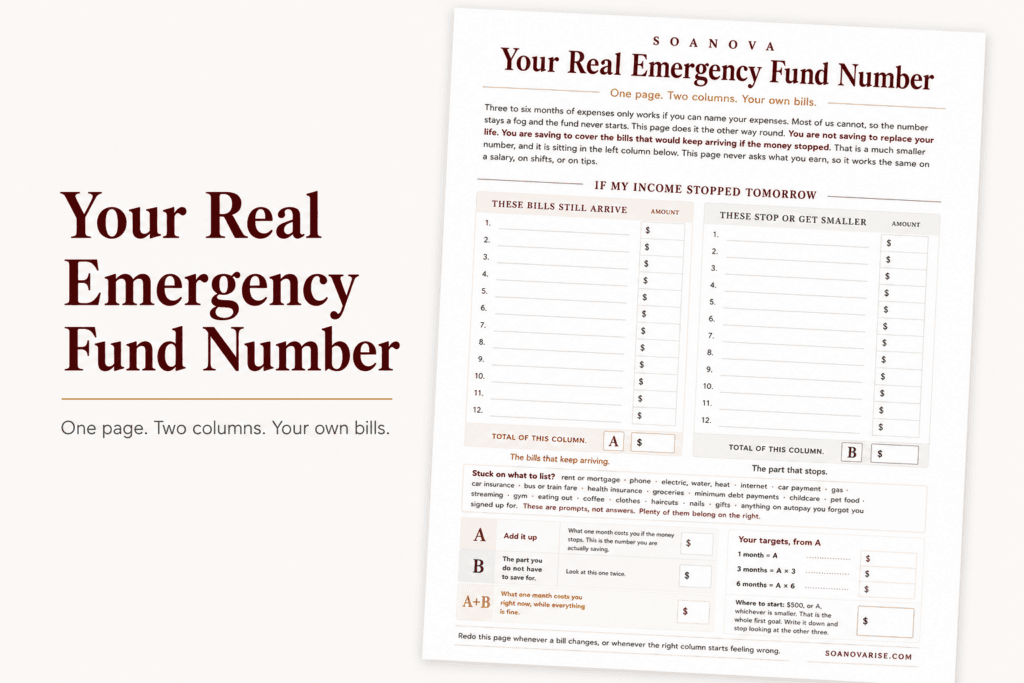
One page. No email needed. Print it, or fill it in on your phone.
The three to six months rule is not wrong. It is just unusable.
Every year the Federal Reserve asks American adults a very simple question. If a $400 emergency landed on you tomorrow, could you cover it?
In the most recent report, published in May 2026, 63% said yes, using cash, savings, or a credit card they would pay off at the next statement. That share has been unchanged for the previous three years and it is down from a high of 68% in 2021. Which means roughly a third of adults could not put their hands on $400 without it costing them something.
And the three month version? 55% of adults said they had money set aside to cover three months of expenses. Down from 59% in 2021.
Sit with that second one for a second, because it is the bit that made me put my coffee down. Nearly half of all adults do not have the thing every finance article treats as the bare minimum starting point! You are not behind. You are standing in an enormous, extremely normal crowd.
The rule assumes you can name your expenses. Most of us cannot. That is a math problem before it is anything else, and math problems have pages you can fill in.
What you are really saving for
This is the shift, and it is the only idea on this page that matters.
You are not saving to replace your income. You are saving to cover the bills that would keep arriving if your income stopped.
Those are wildly different numbers. Your rent does not care that you lost your shifts. Your phone bill does not care. The electricity turns up regardless and it turns up on time, every time, like it has a personal vendetta.
But a lot of what you spend in a normal month is not like that. It gets smaller, or it stops, or it quietly waits. And you already know how to do this, because you have done it before without calling it anything.
My gym membership, for example, is optional on paper. In a bad month it does not feel optional at all, it feels like the last thing keeping me a person, and cancelling it feels like a small death (dramatic! I know). It still goes on the right hand side, because if the money genuinely stopped, it would go.
My hair is another one, and I have not had it cut in far too long. It is long, this weather is humid, and it is driving me INSANE! But a haircut is not a bill. It waits. Ugly truth… but it waits.
The catch I would want a friend to know: when you hesitate over an item, put it on the right. Always. The hesitation is the answer. If you are not sure you would keep paying for something with no money coming in, then you would not, and pretending otherwise just inflates the number you are about to be scared of.
The page, line by line
Print it, or open it on your phone and use the notes app, either one works fine.
- Write down everything you spend money on in a normal month. One item per line, amount next to it. Do not go and check your bank yet, just guess. You can correct it later and you almost certainly will.
- Each item goes on the left or the right. Left is “these bills still arrive”. Right is “these stop or get smaller”. Nothing goes in the middle and no item gets to sit on the fence, sorry!
- Add the left column. That is A. One month of your life if the money stops.
- Add the right column. That is B. This is the part you mostly do not have to save for, and I want you to look at it properly.
- A plus B is what a normal month costs you while everything is fine.
The whole trick is that the page never asks what you earn. Not once. Which means it works exactly the same whether you are salaried, on shifts, on tips, freelance, or on a wildly different amount every single month. The three to six months rule needs you to have a typical month to multiply. Plenty of us do not have one of those, and this page never asks for one.
So. What a filled-in page can look like:
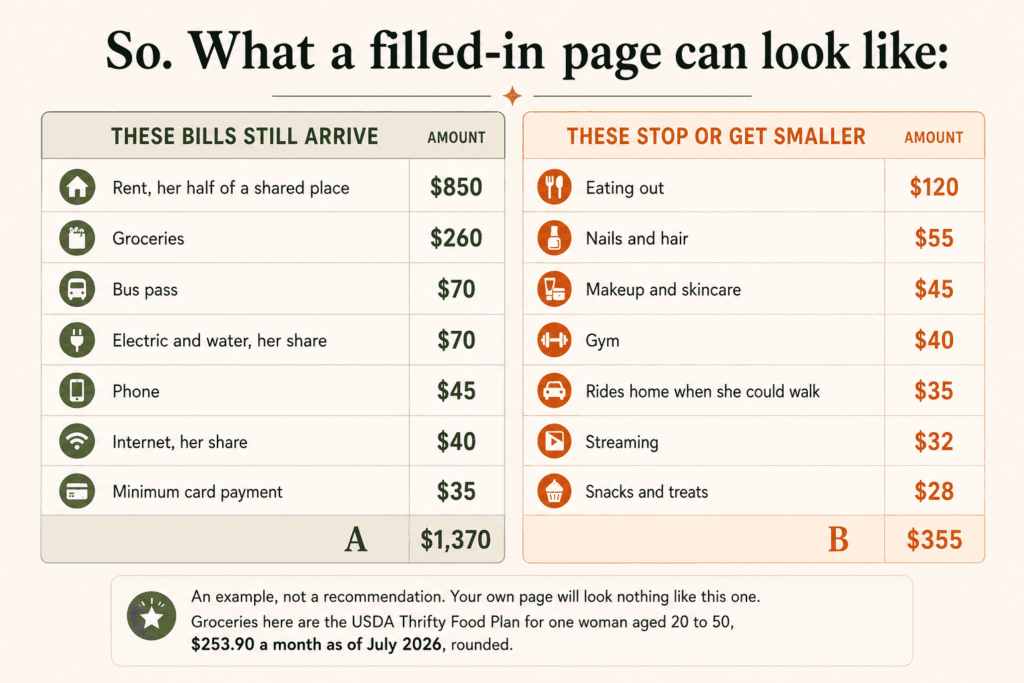
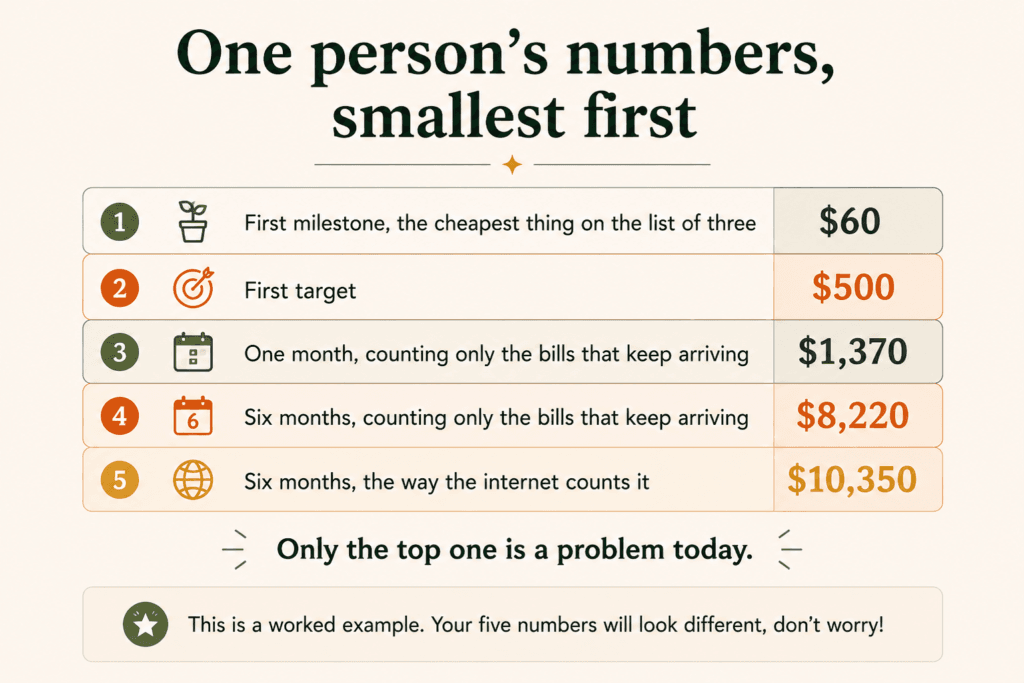
Now look at what that does. Three to six months of a normal month for this person is $5,175 to $10,350. That is the number the internet gives her, and it is the number that makes her give up.
Three to six months of A is $4,110 to $8,220. Still big! Still a long way off. But the month she has to cover is $1,370 rather than $1,725. And she does not start at either of those numbers. There is a smaller first rung than both, and it is coming in a minute.
One caveat, and I would rather give it to you than have you find it yourself in month two. The right hand column says these things stop or get smaller, and smaller is not zero. Her eating out probably drops to $30 rather than vanishing. So A is the floor, not the finished answer, and aiming a little over it is sensible. Even so, a floor of $1,370 and a first goal of $500 is a completely different project from staring at $10,350.
Two notes on that right hand column, because both of them matter. A ride home late at night is not a luxury and it does not go on the right. The rides that go there are the ones you took because you could not be bothered to walk, not the ones you took because it was dark. And some things never change column at all, they simply get cheaper. You still buy shampoo. You just buy different shampoo. That is what “or gets smaller” is doing in that heading.
The B column tends to be the surprise. In the example above it is a fifth of everything she spends, and almost none of it is money you need to insure against anything. You do not have to save for your own eating out. You will simply stop eating out.
I know exactly what that looks like, because there was a stretch where my income was low and unreliable, and the thing I did was stop watching reels. All of it, Instagram and TikTok, just off. Not out of discipline, but because every third video was selling me something, and I could not keep being reminded forty times an evening of things I could not have and did not need. Cutting back turned out to be barely about the shopping list at all. What changes is your whole relationship with wanting things, and you fall into it much faster than you would think.
Name your first three
Now the fun part, and I mean that, this bit is weirdly satisfying!
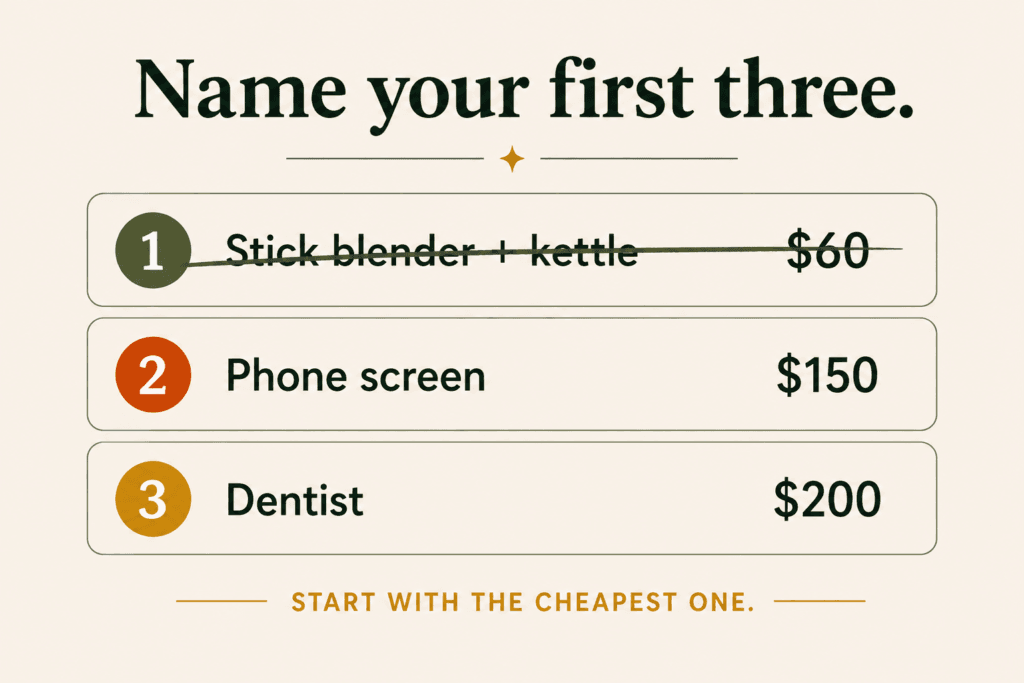
“Emergency fund” is a category, and categories are impossible to feel anything about. So turn it into a shortlist. On the back of the worksheet, or anywhere, write down the three things most likely to go wrong for you in the next twelve months, and what each one would cost.
And yes, I know. An emergency is supposed to be the thing you did not see coming. You still do not know which of the three it will be, or when, or whether two of them will land in the same week, which is exactly how these things like to arrive. Knowing the shape of your likely disasters tells you nothing about the date.
Not the dramatic ones, not job loss and hospital bills, just the boring likely specific things that are already quietly waiting for you. Mine, if I am being honest:
- The stick blender, and by now probably the kettle too. About $60 for both, ugh.
- A cracked phone screen. $120 to $200 depending on where I take it.
- A dentist appointment I have been putting off, which gets more expensive the longer I put it off. Which is a fun little trap!
Three lines. Two minutes, tops. And suddenly the fund has a job! It pays for the blender.
The cheapest thing on your list is your first milestone. Not $500, not A, not three months. Mine is $60, which is a goal I can hit in weeks rather than years, and hitting one is the entire point.
Then it goes in order: the cheapest thing on your list, then $500, then one month of A, and only then the three and six month numbers everybody opens with. Four rungs, smallest first. The worksheet prints $500 as the place to start because it does not know what is on your list, but if your cheapest thing is $60, then $60 is the real first rung and $500 is the second.
Then cross it off and go to the second one. That is the whole game, and it beats staring at $8,220 for a year and touching none of it.
Where to keep your emergency fund, and why separate is not enough
I want to be honest about something, because the standard advice here is not quite the truth.
Every article tells you to keep your emergency fund in a separate account so you do not spend it. Fine, and I do that. I keep money in separate places on purpose and I am reasonably good about it…
And then something big lands, and I pool it. All of it… every app, every account, scraped down to zero to cover one single thing. Separation did not save me, because separation was never the thing that was failing.
What was failing was that I did not know what I was protecting.
If you do not have a number, every pot in your life is fair game, because none of them is ever finished.
That is why the worksheet comes before the account and not the other way round. Once A exists, you know what you are defending, and you know when you are allowed to stop.
So, having said all that: put it somewhere separate anyway. Opening a different app is a few seconds of thinking, and a few seconds of thinking is sometimes enough.
An ordinary online savings account is the right home for this. Not investments, not anything clever, nothing you have to think about twice. Ally’s online savings account pays 3%, which its own page marks as correct as of 28 August 2026, with no monthly maintenance fee and no minimum to open. That last part matters more than the rate when you are starting from nothing. If you want the fuller comparison, the savings challenge pillar has the rate table and a second option for irregular income, so I am not going to repeat it here.
One distinction is worth getting right here, because I have just told you two things that sound opposite. Friction really is useful for savings you are trying not to touch. Three business days between you and your challenge money is exactly what stops you raiding it on a Tuesday, and I have made that whole argument over here, where the section is called the friction is the feature and I meant it.
Emergency money is the one pot where that logic runs backwards. The separation part still helps, so a different app and a moment of hesitation are worth having. The waiting part does not help at all, because the whole point of this money is being able to reach it on a Sunday when something has gone wrong. Challenge money can afford to be slow. This cannot, and if you only have room for one account rule in your head, make it that one.
The one dollar test. Do this today, it takes a minute. Move $1 out of wherever your savings live and into the account you actually spend from. Watch how long it takes to land. Whatever that turns out to be, that is your real access speed. Far better to learn it on a calm Tuesday than on the day the car will not start, and if it turns out to be slow, that is worth fixing now while nothing is on fire.
What counts as an emergency
The test I use has three parts, and the first one is the entire reason this pot of money exists at all. Something unexpected has to have happened. Then the cost has to be necessary, and it has to be urgent. All three. Two is not enough.
One thing makes that test work, and almost everybody gets it backwards. Run it on the situation, not on the receipt. Rent is not unexpected. Rent in a month where your hours got cut absolutely is, because the thing that went wrong was the hours.
- Yes. The car that gets you to work. A tooth. A pet that is unwell. The laptop you work on, if it is the one you earn money on. The flight home when something has happened. Rent, in a month where the income did not turn up.
- No. Christmas. A wedding you have known about since February. Your car’s registration. None of those is unexpected. They have been sitting on the calendar all year in a disguise, and they belong in a sinking fund where you can see them coming.
- The grey zone. This is where necessary is the word people argue about. A cracked screen, when your phone is how you pick up shifts. A car repair you could put off by taking the bus for a month. A flight for something that matters to you and is not a crisis. Yes, my blender.
On the blender. It fails on urgent, and nobody has ever been harmed by a fork, so under my own test it is a no. But I want to say the quiet part, which is that living with small broken things has a cost that never shows up in any budget. It grinds. It works as a small daily reminder that things are tight, and that is its own slow expense. If your fund is comfortably above your first rung and a grey zone item would not set you back, cover it, and do not let anybody make you feel frivolous about it.
The one time to wait
If you are carrying credit card debt at a high rate, there is a real argument for a smaller starter fund and then throwing everything at the balance.
But please do not skip the starter fund entirely, because that is exactly where the trap is. You put every spare dollar at the card, something breaks, and the only thing you can reach is… the card. Round and round we go! A small buffer is what stops the debt payoff from collapsing the first time life happens, which it will.
If that is you, the avalanche and snowball comparison and the 90 day plan are the next two things to read. Come back to this page after.
What I would tell you if we were talking in person
A little while ago I had to ask my dad for money.
It was $200. Not a fortune, not a crisis, just a bill that landed at the very wrong end of a month. And I could not cover it, and I had to say so out loud, to my father, as a grown woman with a job.
Except I did not say it like that. I told him I was saving up for bigger things, a new phone, a tablet, some furniture, and that the timing was just awkward. Which was not a lie exactly. It was the version that let me keep some dignity in the conversation. He gave me the money without asking a single follow up question, and I think that was on purpose, and I have thought about that a lot since.
I felt like such a loser that day.
And then I thought about the number at the top of this page. Nearly half of all adults do not have three months put away. That phone call I was so ashamed of is roughly what this country looks like.
It is happening in millions of kitchens, and every single one of those people also thinks they are the only one.
That day is the reason this page exists. Not the shame, the specific realization underneath it, which was that I had no idea what number would have made that phone call unnecessary. I could not have told you. And you cannot save toward a number you have never once written down.
So go and find out what your emergency fund number is. Ten minutes, one page, one column of things that do not stop. Then pick the cheapest thing on your list of three, and start there. I will be doing the same, with a fork in my hand.
Sources
- Federal Reserve, Economic Well-Being of U.S. Households in 2025, published 13 May 2026, data collected October 2025. The 63% and 68% figures are from the accompanying fact sheet.
- Ally Bank, Online Savings Account. Rate of 3% marked correct as of 28 August 2026. Rates are variable and can change at any time.