
Zero-Based Budgeting for Beginners (Give Every Dollar a Job)
The most popular budgeting method in America, explained without the spreadsheet anxiety. Here is what it actually is, why so many people stick with it, and how to build your first one this month.
Here is how most people budget, and I mean most people, not just you. The paycheck lands, the bills get paid, life happens for a few weeks, and whatever is still sitting in the account near the end of the month becomes savings, if there is anything left to call savings at all. According to The Penny Hoarder’s State of Savings survey, about 48 percent of Americans budget exactly this way, saving only whatever happens to be left over. And whatever’s left is rarely a number that adds up to real security (it is usually a number that adds up to nothing, if we are honest).
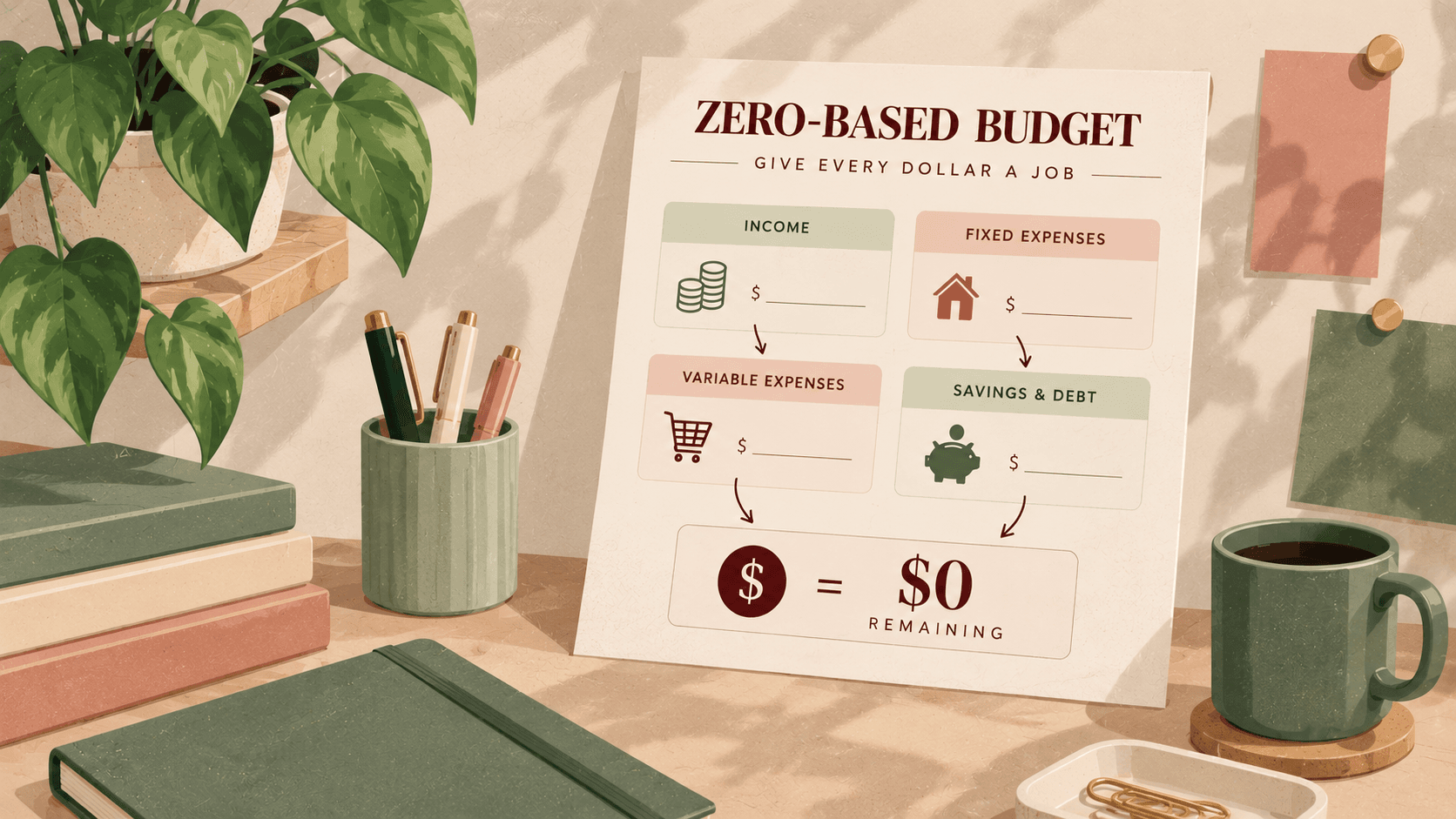
Zero-based budgeting flips that order around entirely. Instead of paying everything and hoping something survives, you decide where every single dollar is going before the month even starts, bills, groceries, debt payoff, savings, the fun money too, until your income minus everything you have assigned equals exactly zero. Nothing sits around unassigned waiting to get spent by accident, because there is nothing left unassigned to spend.
What zero-based actually means
The math behind it is genuinely simple: income minus expenses equals zero. That does not mean you spend everything you earn, which is the part that trips people up first. Savings, debt payoff, and investing all count as line items with jobs of their own, exactly the same as rent or your phone bill. A zero balance just means every dollar has a destination, including the dollars headed straight into your emergency fund.
Example: On a 4,800 dollar take-home month: 2,600 to fixed bills like rent, insurance and subscriptions, 700 to variable costs like groceries and gas, 900 to debt payoff and savings goals, 500 to discretionary spending, and 100 to a sinking fund for irregular costs like car repairs. Total allocated: 4,800. Remaining: 0.
A corporate turnaround trick that moved into your kitchen
Zero-based budgeting did not start as a personal finance trend, which honestly makes it more interesting. It started life as a corporate accounting tool. Peter Pyhrr, an accounting manager at Texas Instruments, developed the method in the late 1960s to force every department to justify its entire budget from scratch each year, rather than simply padding last year’s number and calling it done.
He wrote it up for Harvard Business Review in 1970, and the article did not stay inside the finance world for long. Jimmy Carter noticed it while governor of Georgia, hired Pyhrr in 1973 to bring zero-based budgeting to the state’s budget process, and then took the same method with him to the federal government once he reached the White House. Decades later, the exact same give-every-dollar-a-job logic resurfaced in personal finance, reframed for regular households by budgeting apps and money coaches. Same idea, much smaller budget, same result: nothing gets to hide.
Why people actually stick with it
Zero-based budgeting is now the single most used method among people who budget at all. According to Self Financial’s household budget survey of over a thousand adults, 33.3 percent use it, more than any other approach, ahead of the 50/30/20 rule at 25.6 percent, the envelope system at 19.6 percent, and pay-yourself-first at 14.3 percent.
The appeal comes down to precision. Because every dollar is pre-assigned before you spend it, overspending in one category cannot quietly hide the way it can inside a vaguer plan. You see it the moment it happens, which is a large part of why this method is a favorite among people paying down debt aggressively or trying to break out of a paycheck to paycheck cycle for good.
| Stat | What it tells you |
|---|---|
| 33.3% of budgeters use zero-based budgeting | It is the single most popular method, ahead of every alternative |
| 48% of Americans only save whatever is left after bills | This is the exact habit zero-based budgeting is designed to replace |
| About 3 months to get comfortable | Per Ramsey Solutions, most people need this long before it takes 15 to 20 minutes a month |
How to build your first zero-based budget
Most guides converge on roughly the same six steps, so here they are without the padding. Expect the first month to feel a little clunky. Ramsey Solutions notes it typically takes about three months before building the budget only takes fifteen to twenty minutes, and that timeline matches what most people I know experienced too.
- Total your monthly income. Wages, side gigs, and anything else reliably coming in, counted after tax. If your income varies month to month, budget off your lowest realistic month rather than an optimistic average.
- List your fixed expenses. Rent or mortgage, insurance, minimum debt payments, subscriptions, anything that does not change from month to month.
- List your variable expenses. Groceries, gas, and utilities that fluctuate. Estimate generously here, using last month’s actual statements as your guide rather than guessing low.
- Add savings and debt payoff as their own line items. Emergency fund contributions, retirement, extra debt payments, and sinking funds for irregular costs like car repairs or holidays all get treated like bills, not like whatever happens to be left over.
- Assign every remaining dollar, including the vague miscellaneous category, until income minus allocations equals exactly zero.
- Track and adjust all month long. Moving money between categories as real life happens is not a failure of the system, it is the system working as intended. A zero-based budget is a living plan, not something you lock and forget.
A quick reassurance before you start
A zero balance does not mean draining your checking account down to the last cent, and if that thought is making your stomach drop a little, good, let’s fix it now before you start.
Good to know: Most coaches recommend keeping a small buffer in checking on top of your zero-based plan. Ramsey suggests somewhere between 100 and 300 dollars, so a rounding error or a slightly early charge does not bounce a payment. Build that buffer in as its own line item on month one, and then mostly forget about it.
Zero-based budgeting versus the 50/30/20 rule
The most common alternative you will run into is the 50/30/20 rule, popularized by Senator Elizabeth Warren, which splits your after-tax income into 50 percent needs, 30 percent wants, and 20 percent savings and debt. It is a guideline. Zero-based budgeting is a full accounting, and the difference in effort between the two is real.
| Zero-based budgeting | The 50/30/20 rule | |
|---|---|---|
| Setup effort | High. Every category is built by hand each month | Low. Three broad buckets and you are done |
| Ongoing effort | Needs regular tracking and adjusting | Minimal upkeep once it is set |
| Precision | Every dollar named and tracked individually | Broad percentages, less visibility into specifics |
| Best for | Aggressive debt payoff, tight budgets, irregular income | Beginners, or a simpler overall financial picture |
| Where it tends to fail | Gets abandoned once tracking starts to feel like a chore | Can quietly hide overspending inside the wants category |
One detail from the Self Financial survey I found genuinely useful: budgeters earning between 20,001 and 40,000 dollars were the only income group that preferred 50/30/20 over zero-based budgeting. Everyone else favored ZBB. That is a small reminder worth sitting with, that the best method is the one that matches your actual bandwidth this season, not necessarily the one with the most impressive results on paper.
The tradeoffs, honestly
- Strength: nothing hides. Overspending shows up the moment it happens, not thirty days later when the statement arrives.
- Strength: it forces intentional saving and debt payoff, rather than treating them as whatever happens to survive the month.
- Strength: genuinely flexible for irregular income, since you build the plan around the money that actually arrived rather than an assumption.
- Watch-out: it requires real upfront planning, and it asks you to keep tracking all month rather than setting and forgetting.
- Watch-out: it can feel rigid if you are brand new to budgeting and were hoping for something looser to start.
- Watch-out: without that small buffer we just talked about, an unexpected expense can cut uncomfortably close.
Is it actually right for you?
Zero-based budgeting tends to work best for people who want real control over their money and are genuinely willing to put in the ongoing effort to maintain it, especially if you are paying off debt aggressively or trying to break a paycheck to paycheck pattern. If you are brand new to budgeting entirely and you already know detailed monthly tracking is not going to stick, start with 50/30/20 instead, and graduate to zero-based once the habit itself has taken hold.
The honest truth is that the best budgeting method is whichever one you are still actually using in month three. Everything else is just theory.
Where to start this week
Grab your last full month of bank statements, and just do the six steps once, roughly, without trying to make it perfect. A rough zero-based budget you actually finish beats a flawless one that stays a tab open in your browser forever.
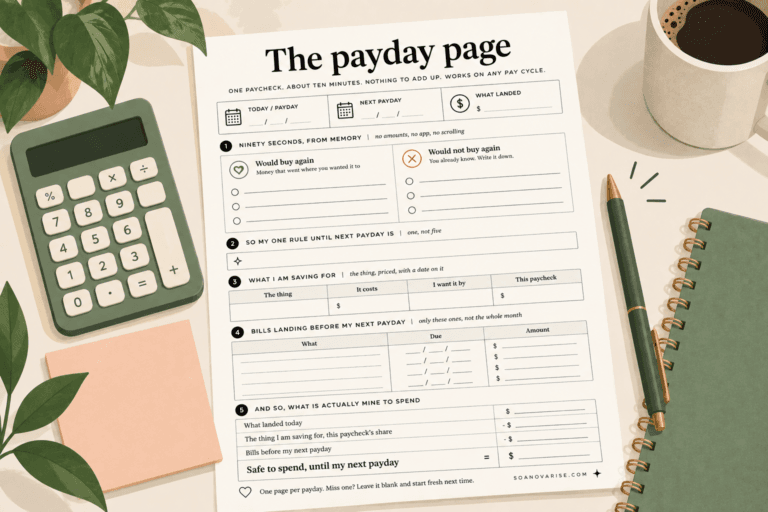
If you want a head start, our free budget template already has the categories laid out with sinking funds built in, so you are filling in numbers rather than staring at a blank page.
You do not need to get this exactly right in month one. You just need to start, and adjust from there. You have got this. Genuinely.



One Comment