

How to Start Investing with $100
I lost money trading. Not a life-ruining amount, but enough that I still think about it, and enough that I stopped for a long time afterwards.
The part that stung was not the loss. It was that I never really understood what I was doing. I would open the app and there would be a word I did not know, so I would google it, and the definition would contain two more words I did not know, and forty minutes later I had eleven tabs open and still could not tell you which button I was supposed to press. Equities. ETFs. Spot. Futures. Margin. Limit orders… ugh.
So when someone asks me how to start investing with $100, I know what she is really asking. She is not asking about returns. She is asking: what happens when I open this thing and it starts asking me questions I cannot answer?
That is the whole wall. Not the money. The form.
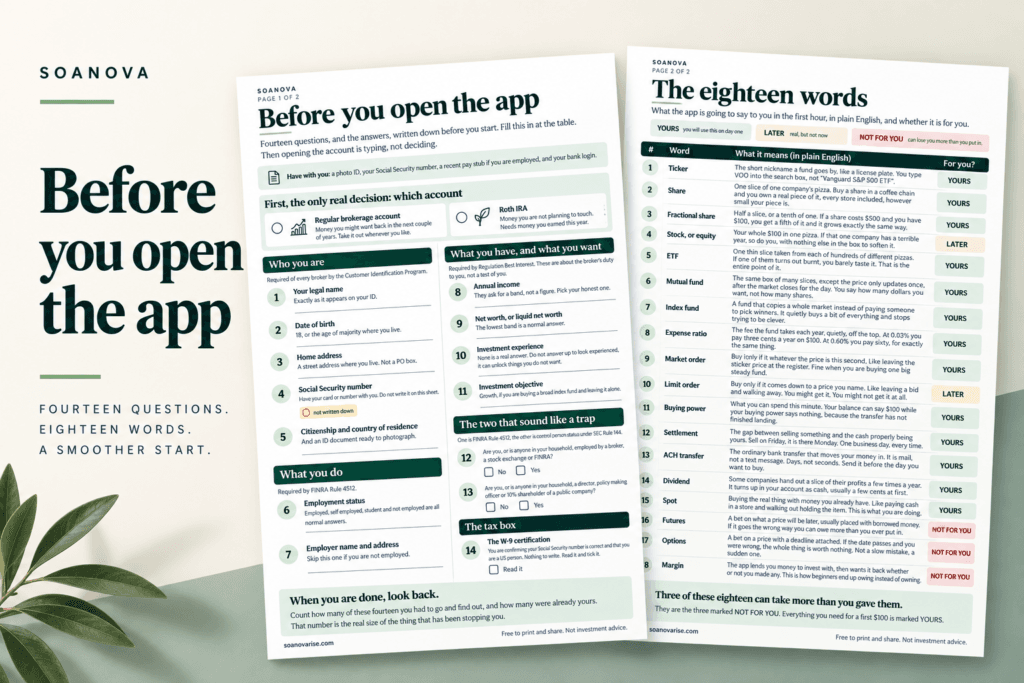
This article is the form. Every question the app is going to put in front of you, what each one means in plain English, what to put, and which ones sound like a test but are just paperwork. There is a free two page sheet further down so you can fill in your answers at your kitchen table before you open anything, and turn the whole thing from a decision into typing.
Two situations where this $100 has a better job
Before anything else, because I would rather lose your click than have you do this in the wrong order.
If you are carrying a balance on a credit card at 20% or more, that card is the better use of this $100. You are being charged more than the market has historically paid, so clearing the card is the higher and more certain return. The order you pay them off in is its own subject and I have written about it in avalanche versus snowball. And this is only about the high interest card, by the way. A student loan at 5% is a different animal and it does not have to be gone first.
The second one is if a surprise bill would currently go on a card, because there is nothing sitting behind you. Money in a brokerage account is still yours, but it is not Tuesday money, and selling something at a bad moment because your car needed a part is the exact situation you want to design out. I have a whole page on what your own number is, with a worksheet, at how much emergency fund do you need. Even a small buffer changes this!
If neither of those is you… keep going. And if one of them is, you have not failed at anything, you have just found out what this $100 is for.
Question zero: the only one that is a real decision
The very first screen asks you to choose an account type, and this is the only question in the whole flow where you are choosing something rather than reporting a fact about yourself. Everything after it is admin.
You will see a long list. Ignore most of it. For you it is two:
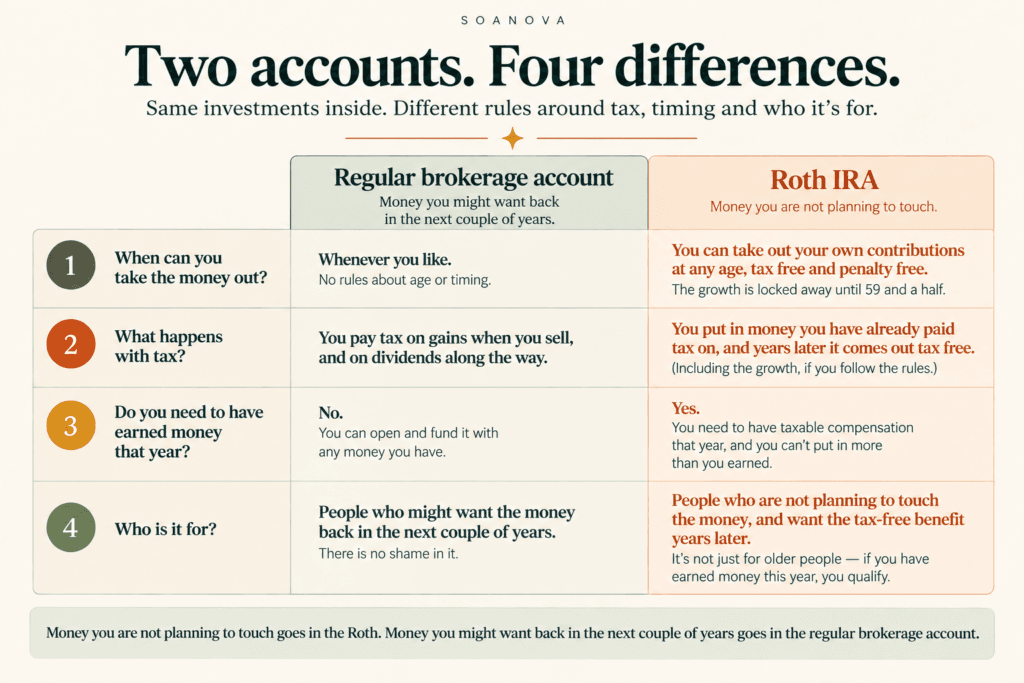
A regular brokerage account (they might call it an individual account, a taxable account, or self directed). Money goes in, money comes out, whenever you want. You pay tax on gains when you sell, and on dividends in the year they are paid, even if they are automatically reinvested. No rules about age or timing.
A Roth IRA. Same investments inside, different tax wrapper. You put in money you have already paid tax on, and years later it comes out tax free.
And the thing nobody said to me for years, so I am saying it to you: a Roth IRA is not an old person’s account. The IRS states that since 2020 there is no age limit on making regular contributions. What it requires is that you had taxable compensation that year, and that you do not put in more than you earned. That is it. A nineteen year old with a part time job qualifies! The income limits you may have read about are the ones that lock high earners out, which is the opposite of a problem you have.
The part I would want a friend to know: in a Roth, your own contributions come out first, and they come out tax free and penalty free at any age. The IRS ordering rule is that contributions are distributed first and are not included in income. What is locked away until 59 and a half is the growth, not the money you put in.
What is locked away until 59 and a half is the growth. Not the money you put in.
Three honest catches, because that sentence is one step away from “use it as a savings account”, which quietly costs you the thing the account is for.
- The room does not roll over. Take $100 out and you do not get that year’s space back.
- There is a five year clock that starts at your first contribution, which is a quietly good reason to open one early even with a small amount in it.
- If you know you want this money in two years for a move or a trip, take the regular brokerage account. There is no shame in it and it is the right answer.
How to pick, in one line: money you are not planning to touch goes in the Roth. Money you might want back in the next couple of years goes in the regular brokerage account.
The 14 questions, and why none of them can disqualify you
Now the part that made me close the app the first time.
You are about to be asked about your income, your employer, your net worth, whether you are a company director, and whether anyone in your household works at a stock exchange. It reads like a screening. It is not! Every one of these is something the broker is legally required to collect, and I want you to see the actual rules, because knowing a question is a compliance box rather than a judgement completely changes how it feels to answer it.
Roughly in the order you meet them. No broker asks all fourteen in the same sequence, and this is compiled from the brokers’ own application forms and help pages rather than a published screen by screen flow, so treat the order as approximate.
| # | What it asks | Why it is asking | What to put |
|---|---|---|---|
| 1 | Legal name | Customer Identification Program | As it appears on your ID |
| 2 | Date of birth | Customer Identification Program | You must be 18 |
| 3 | Home address | Customer Identification Program, and it has to be a street address | Where you live, not a PO box |
| 4 | Social Security number | Customer Identification Program | Yours. Required |
| 5 | Citizenship and country of residence | Identity verification | The truth |
| 6 | Employment status | FINRA Rule 4512 | Student, employed, self employed and not employed are all normal answers |
| 7 | Employer name and address | FINRA Rule 4512 | If you are not employed, this disappears |
| 8 | Annual income | Regulation Best Interest | A band, not a number. Pick your honest one |
| 9 | Net worth or liquid net worth | Regulation Best Interest | The lowest band is a normal answer |
| 10 | Investment experience | Regulation Best Interest | “None” is a real answer. Use it if it is true |
| 11 | Investment objective | Regulation Best Interest | Growth, if you are doing what this article says |
| 12 | Are you affiliated with a broker dealer, exchange or FINRA | FINRA Rule 4512 | Almost certainly no |
| 13 | Are you a director, policy making officer or 10% shareholder of a public company | SEC Rule 144 control person status | Almost certainly no |
| 14 | Tax certification, the W-9 bit | IRS | You are confirming your SSN is right and that you are a US person |
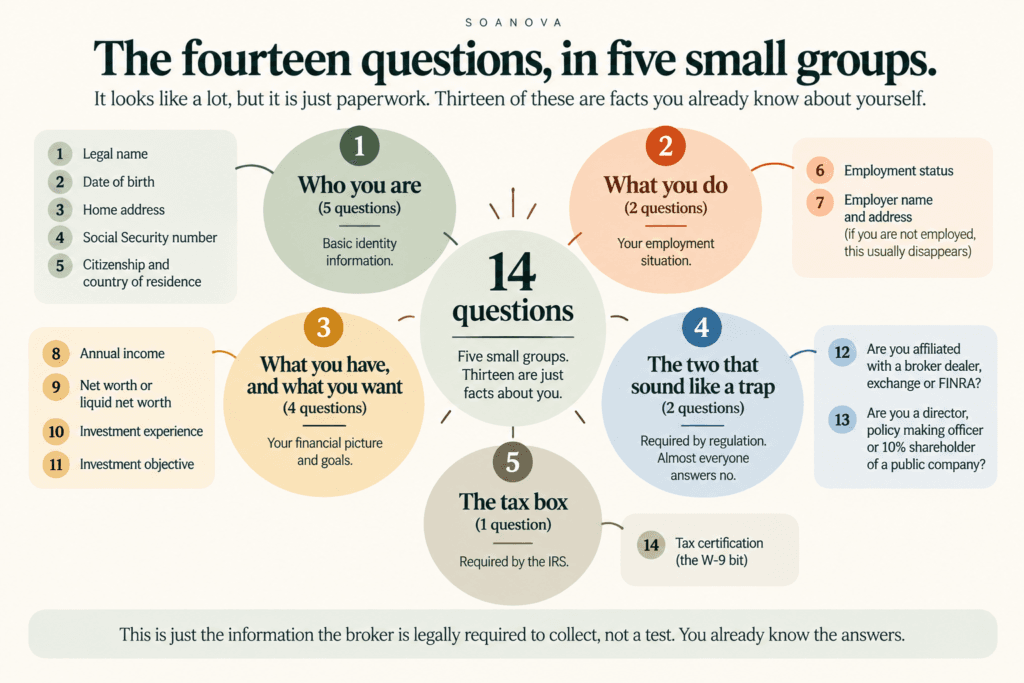
Four notes on the ones that make people freeze.
The identity block, 1 to 5. Robinhood says in its own help pages that it collects this “in order to comply with US government laws and FINRA rules”, under an SEC customer identification rule of the USA Patriot Act. It is the same rule your bank used on you when you opened your checking account. None of it is specific to investing.
The income and net worth bands, 8 and 9. These exist so that if the firm ever recommends something to you, it can show the recommendation suited your situation. That is Regulation Best Interest, and it is a rule about them, not a hurdle for you. The lowest band is not a rejection criterion. Nobody is reading it and deciding you are not serious enough. Promise!
Question 10, and this is the one I would get wrong if I were you. There is a real pull toward ticking “good” or “extensive” so you do not look like a beginner. Please do not. Answering up on experience is one of the things that can unlock features you do not want unlocked, options trading being the big one. Ticking “none” costs you nothing and buys you a small piece of protection.
Questions 12 and 13. Fidelity’s own form asks whether you, your spouse, or a relative living at your address is “a member of the board of directors, a 10% shareholder, or a policy-making officer of a publicly traded company”. Even if the answer is yes it does not stop you, it just means some extra paperwork or a note to your employer. For almost everyone reading this it is one tap and it is over. Phew.
There is no answer here that gets you turned away for being twenty two with a part time job and a hundred dollars.
Getting the money in, and why it just sits there
This is the half step nobody writes down, and it is where I have watched people assume something has gone wrong with them.
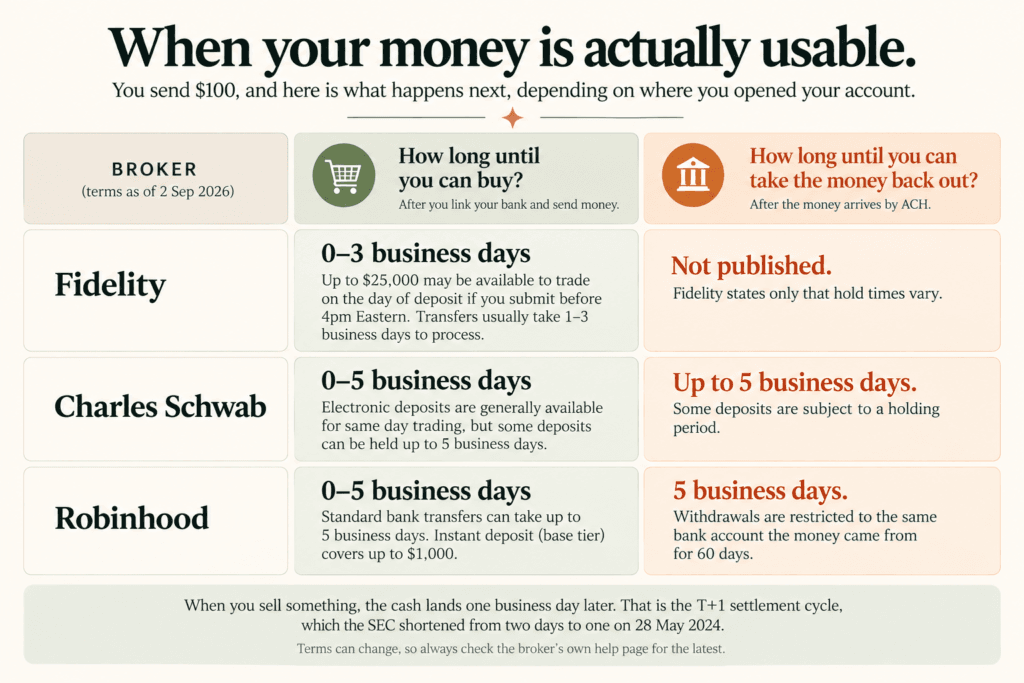
You link your bank, you send $100, and then one of three things happens depending on where you opened the account… some of it may be usable straight away, some of it may sit for a few days, and even after you buy something, the cash from selling it is not instantly yours either.
Depositing. Schwab says electronic deposits into a brokerage account are “generally… available for same day trading”, with a note that some deposits can be held up to five business days. Fidelity says an electronic transfer takes one to three business days to process, but makes up to $25,000 available to trade on the day of deposit if you submit before 4pm Eastern. Robinhood is slower at both ends for a beginner: standard bank transfers “can take up to 5 business days”, its instant deposit at the base tier covers up to $1,000, and money that arrived by ACH has to sit for five business days before you can withdraw it. Robinhood also restricts withdrawals to the same bank account the money came from, for sixty days.
Selling. When you eventually sell something, the cash lands one business day later. That is the T+1 settlement cycle, which the SEC shortened from two days to one on 28 May 2024. So a Friday sale settles on Monday. It is not the app being slow, and it is definitely not you doing it wrong!
Now, I have argued elsewhere on this site that slow transfers are a good thing, and I stand by it, so let me be clear about which pot I meant. In where to keep your savings challenge money the delay is protective, because it stops you raiding money you promised yourself you would not touch. That is a different pot. A brokerage deposit is money you are deliberately leaving alone anyway, so here the wait is just a wait. Plan around it, and do not send money on the same day you want to buy.
What to buy, in one decision
You are going to be shown thousands of things, and it will feel like the choosing is the skill. It is not, and I say that as someone who tried to make the choosing the skill and lost money doing it.
Three words first, because these are the ones that stalled me. The first time I tried this, on a trading app, it offered me spot or futures on the same screen, in the same size type, and I sat there not knowing which one I was supposed to want. Nobody had told me one of them was just buying, and the other was borrowing.
- A stock (also called an equity) is a slice of one company. All your eggs, one basket.
- An ETF is a box holding hundreds of companies. You buy one thing, you own a sliver of all of them, and it trades like a stock.
- A mutual fund is the same idea in an older wrapper. You buy it in dollars, and it prices once a day instead of continuously.
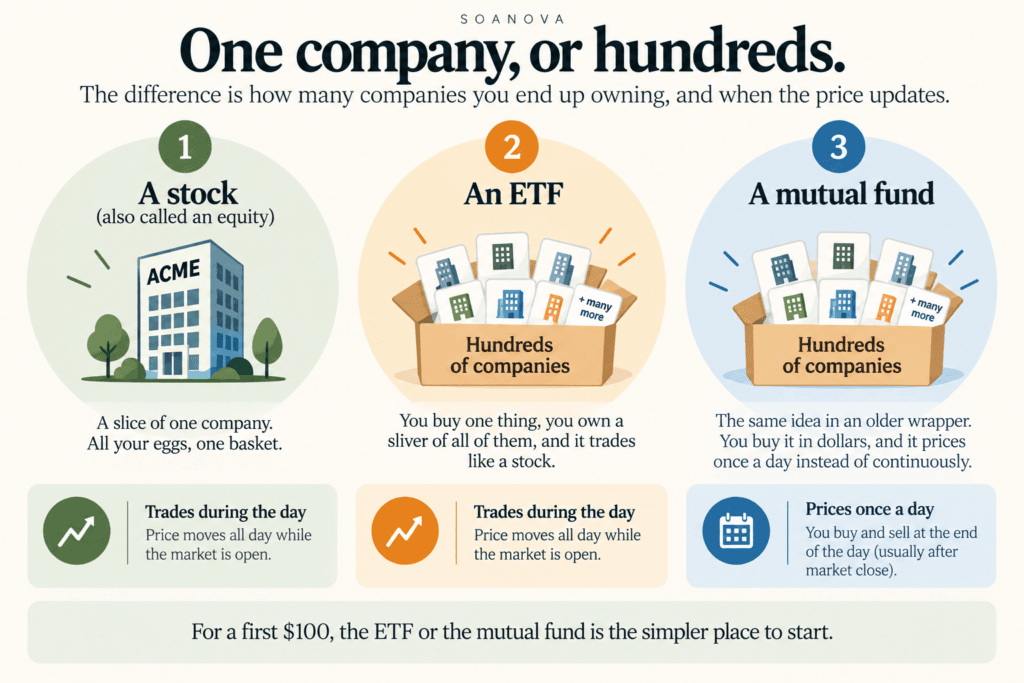
For a first $100 the boring answer is a broad index ETF, which is a box holding a very large chunk of the US market. Owning a small slice of the whole thing, then going away and living your life. That is the entire strategy.
| Fund | Ticker | Type | Expense ratio | The catch |
|---|---|---|---|---|
| Vanguard S&P 500 ETF | VOO | ETF | 0.03% | Holds the 500 biggest, not the whole market |
| Vanguard Total Stock Market ETF | VTI | ETF | 0.03% | None worth naming |
| Fidelity ZERO Total Market Index | FZROX | Mutual fund | 0% | Only exists inside a Fidelity account |
That expense ratio is what the fund takes each year to run itself. At 0.03% it is three cents a year on a hundred dollars, so it is not the thing to lose sleep over at this size… but it is worth knowing the number exists, because plenty of funds charge twenty times that for no extra benefit whatsoever, and the sheet at the top of this page shows you what that costs.
The FZROX line needs saying out loud, since a 0% fee looks like the obvious win. Fidelity’s own prospectus says the fund’s shares “are available only to individual retail investors who purchase their shares through a Fidelity brokerage account”. So the zero comes attached to staying at Fidelity. That may well be fine! Just know you are choosing it.
“But I cannot afford a whole share.” You do not need one. Fidelity, Schwab and Robinhood all sell fractional shares of most US listed stocks and ETFs from $1. Schwab widened its fractional trading to cover ETFs and dropped its minimum to $1 in June 2026, which is recent enough that older articles will still tell you otherwise. So $100 buys you a piece, and the piece behaves exactly like a whole share does.
One caveat that matters later rather than now: fractions generally cannot be moved to another broker. Fidelity and Schwab both say fractional positions get sold instead of transferred. Not a reason to avoid them! Just a thing to know before you go and open six accounts.
Where to open it, honestly
I am not giving you a ranked list of nine brokers, because a list of nine is the exact wall this article exists to remove.
If your goal is to start investing today and be finished today, Schwab says most accounts are approved within minutes online, has no account minimum, does $1 fractional ETFs, and generally makes electronic deposits available for same day trading. Fidelity matches it on minimums and fractional buying, and it is the only one of the three where FZROX is available at all.
Robinhood is the one you have probably heard of, and I want to be straight about it rather than quietly leave it off. Its own help pages say applications are reviewed within one to two weeks, standard bank transfers take up to five business days, deposited money has to sit five business days before it can be withdrawn, and for sixty days it can only go back to the bank it came from. None of that is sinister. It just means it is not the account that gets you finished in one sitting, which is the thing this article promised you.
On the numbers above: all of this comes from each firm’s own site, help center and pricing pages, read on 2 September 2026. Terms and timings change, so check the number on their page before you rely on it.
Three things that will scare you, and only one is real
Red numbers. Your $100 will be worth $96 at some point, possibly in the first week, and your stomach will drop through the floor. Nothing has gone wrong. A share price moving is the thing it does all day, and you have not lost anything until you SELL. S&P Dow Jones Indices says its own index has posted roughly a 10% annualised total return since it launched on 4 March 1957, and that number already contains every crash you have ever heard of. Past performance is not a promise about your next month, and anyone who tells you otherwise is selling something.
The charts. Every app puts one on the front page, with lines and time ranges and little peaks, and it looks like something you are supposed to be able to read. (You are not.) Charts are a tool for people trying to guess short term direction, and you are doing the opposite of that on purpose. Looking at it more often will not improve the outcome and it will absolutely make you feel worse, so my honest advice is to check it about as often as you check your passport.
Futures, options and margin, and this is the one to take seriously. The app will offer these to you, sometimes quite enthusiastically. Spot just means buying the actual thing, with money you already have, which is what you are doing. Futures and options are bets on where a price goes later. Margin is investing with borrowed money. All three can lose you more than you put in. This is the world I wandered into, and it is where my money went, and it went fast! Not this year, and honestly not until someone can explain to you exactly how much they can take from you… which is never going to be the promotional banner offering them.
Your first hour, and the sheet
So, how to start investing with $100, in the order it happens. Print the sheet. Fill in page one at the table with your ID and a pay stub next to you, then open the app and type. Page two has the eighteen words the app is going to throw at you, each with a plain definition and whether it is for you or not.
Then, in order: choose the account type, answer the fourteen, link your bank, send the money, wait for it to be usable, buy one broad index ETF in dollars rather than shares, and set up a small automatic transfer for next month if you can. That is it! That is the whole thing.
And if you want the money for that transfer to come from somewhere deliberate rather than from whatever happens to be left over, zero-based budgeting is the method I would point you at, or the savings challenges matched to your paycheck if a plan works better for you than a rule.
What happens next is nothing, and that is the point
I have $50 in silver sitting in an account right now. I am not going to look at it for a few years.
Silver is what I picked, and I am not telling you to pick it, and that is genuinely not the part of the story that matters. The part that matters is that the account exists, the money is inside it, and the whole thing has gone quiet. No tabs. No googling at midnight. No opening the app to see what a line did.
That is what getting past the form buys you. Not returns, not yet, not for years. Just the end of standing outside it, swapped for something so uneventful you forget it is happening.
Fifty dollars and a shrug. Start there.
