
5 Savings Challenges for Beginners, Matched to Your Paycheck
Most savings challenges are built for a woman who gets paid on the first of the month, has the same amount spare every single time, and never has a week where the car makes a noise it has never made before. I have never met her!
I want to say the thing that took me an embarrassingly long time to work out… when a savings challenge falls apart it is almost never because you stopped caring. It is because the schedule printed on the tracker and the schedule your money actually arrives on were never the same schedule, and one of them was always going to win.
Mine went like this. I was not doing okay. Not dramatically, nothing you would have noticed from the outside, just quietly, in that way where you are answering emails and showing up and also somehow not really there. And I knew exactly what I needed, which was my friends, in my hometown, in the same room as me and not on a screen. So I booked the flights. The entire paycheck. Aaaghhh.
And the thing is… I do not regret it! Not for a second, I would book them again tomorrow. What I regret is the two weeks after, when I sat there feeling like I had failed at a savings challenge, when what had happened is that a fixed weekly number ran into a month that was never going to be a normal month. There was no row on the tracker for “went home because I needed to”. There never is.
Your pay cycle is the plan. The tracker just has to agree with it.
So this is five challenges, sorted by how you get paid rather than by how pretty the printable looks. Find your row, take the one that matches, ignore the other four. And a challenge that survives one strange month is worth more than a beautiful one that does not.
If the reason you want a challenge at all is that a surprise bill would currently flatten you, I have put the numbers on how common that is, and what to aim for, in the emergency fund post. This one is about the machinery. Which challenge, which amount, and how to make it survive a month that goes sideways.
Find your row
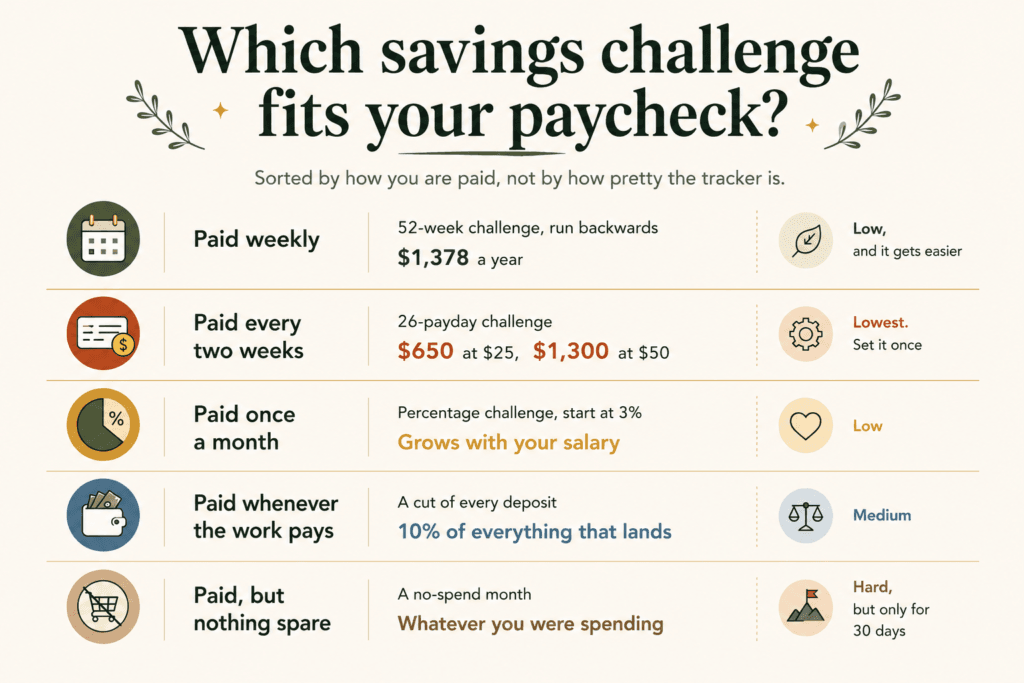
If you are not sure which row is yours, you are probably in the biggest one. The Bureau of Labor Statistics counted private establishments in February 2023 and found 43% paying biweekly, 27% weekly, 19.8% twice a month and 10.3% monthly. Note it is establishments and not employees, so this is how many workplaces run each cycle rather than how many people sit inside them.
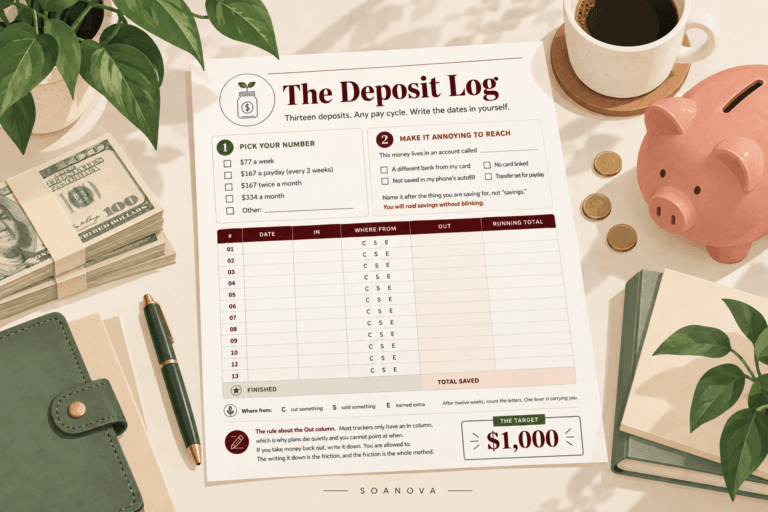
One page, free, no email. Twelve numbered deposit lines with a blank date column, so it fits whichever row you just picked instead of assuming you are paid on a Friday. There is one column on it that most trackers do not have, and it is the entire point of the page. More on that at the bottom, once you have picked your challenge.
Paid weekly: the 52-week challenge, backwards
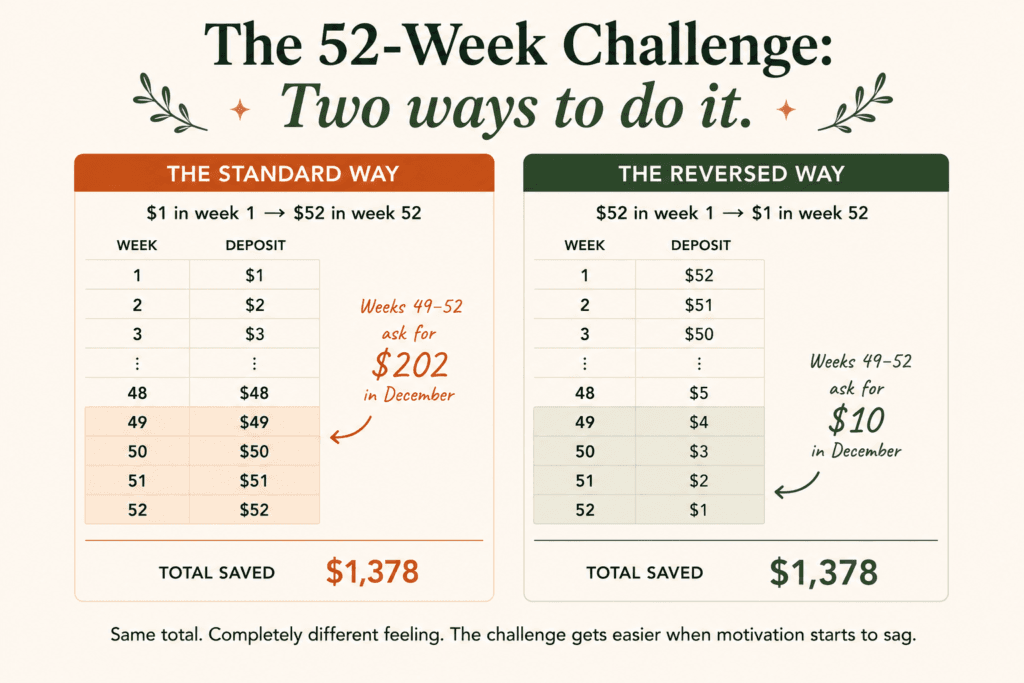
The famous one! A dollar in week one, two dollars in week two, all the way up to fifty-two, and it adds up to $1,378 by the end of the year.
The design flaw is in the last month. Weeks 49 to 52 ask you for $202 in December. December!! The month you are already buying gifts and paying for travel and quietly panicking about the credit card. The hardest four weeks of the challenge sit inside the most expensive four weeks of the year. Somebody printed that on a tracker, sold it as a beginner plan, and then let you take it personally when it broke. Oof.
So run it in reverse. Fifty-two dollars in the first week of January, fifty-one in the second, and every single week after that asks you for less than the one before. Same total, completely different feeling, because the challenge gets easier at exactly the point where your motivation starts to sag… and December costs you ten dollars instead of two hundred.
If January is your tight month rather than December, flatten it instead. $26.50 a week gets you to the same $1,378, and rounding up to $27 a week gets you $1,404 with no thinking involved at all. I have written the whole argument out properly in the 52-week savings challenge post, including the bit where I finally finished it.
Paid every two weeks: the 26-payday challenge
You get 26 paychecks a year. That is the entire structure, and this is the easiest of the five by a distance.
Pick one amount. Set a transfer for payday morning. Then do nothing else for a year… that is it, that is the challenge.
$25 a payday is $650. $50 a payday is $1,300. And if neither of those is possible right now, $10 a payday is $260, and $260 is the tire.
This one asks you for a decision once and then never asks again, which is the good news, because my capacity for daily decisions runs out somewhere around the 20th. Money that leaves the account before you have looked at the balance is money you never had a conversation with yourself about. There is no evening where you weigh the savings transfer against dinner, because the transfer already happened while you were asleep. Heheheh.
And twice a year the calendar hands you a present. Twenty-six paydays do not divide evenly into twelve months, so two of your months get three paychecks instead of two. Your bills are already covered by the first two! Go and find out which months yours land in, and decide now what the third one is for, because if you decide in the moment it is going on something you will not remember by March.
Paid once a month: the percentage challenge
A flat dollar amount is a strange fit for a monthly salary, because a fixed number that felt fine in March quietly turns into a burden by November when everything else has crept up.
So save a percentage instead. Start at 3%… and every month or two, add one point.
Three percent of most salaries is small enough that you will not feel it leave, which is exactly the point, because the version of this you can feel is the version you cancel in month four. By the time you notice you are at 8%, you have already been living on 92% for months and it turned out to be completely survivable. Percentages also survive a pay rise without you having to think about it… the amount goes up, the lifestyle stays where it is, and the raise does not silently become a bigger grocery habit.
If you have no idea what your starting percentage should be, the honest answer is that you cannot pick one from feeling. Run a zero-based budget for one month first and let the leftover tell you.
Irregular income: a cut of every deposit
Freelance, gig work, commission, tips, a business that has good months and quiet ones. Every fixed-schedule challenge is wrong for you, because the schedule assumes an amount you cannot promise anybody.
The rule is one line. Every time money lands, a percentage of it moves the same day… no negotiating with yourself about whether this invoice counts.
Ten percent is the number most people reach for. Three to five works beautifully and beats the ten percent you keep postponing until a bigger invoice arrives. What makes it work is that it flexes on its own. A thin month asks almost nothing of you. A good month quietly does the heavy lifting, and you get to feel clever instead of guilty for once.
One warning, and it is the one that ruins Aprils. If you are self-employed, your tax money is not your savings. Send it somewhere separate, on the same day, in the same motion. A savings balance you have to raid in April was a tax bill wearing a nice outfit the whole time.
Nothing spare: a no-spend month
If the gap between what comes in and what goes out is close to zero, none of the four above have anything to grip on to. So change the other side of the sum for thirty days.
Pick the month. Write down the exact categories that are switched off. Not “no spending”, because “no spending” is a feeling and it will lose an argument with a Tuesday. Delivery apps, clothes, the coffee on the way in, whatever yours genuinely are, written down before day one and stuck somewhere you will see them.
Then move the money, and this is the step that gets dropped: move it the same day. If the coffee did not happen, the coffee’s money goes into savings that afternoon. Otherwise it stays in checking and dissolves into the month, and you finish thirty days of restraint with nothing to show for it except being mildly irritated.
What you get at the end is usually the list, more than the money. And mine was not what I expected at all! It was storage. Apple wanting money for iCloud, Google wanting money for Drive, both of them small enough that I have genuinely never checked what they cost, and both of them landing at the end of the month at the precise moment my account is already hanging on by a thread. My god. Thirty days of writing things down showed me the timing. The amount was never the problem.
You will not guess your own category correctly, and finding it out is worth thirty days on its own.
Where the money sits, and how it gets there
You can pick the right challenge and still lose the money, and the way you lose it is so boring. It sits in checking, it looks like spendable money, and then one Thursday… it simply is spendable money.
Two things have to be true. It has to be somewhere that is not one tap away from your card, and the move has to happen without you agreeing to it every single time.
For the first, a separate savings account with a name on it. The national average savings rate was 0.38% in August 2026, which is a rounding error dressed up as interest, and the gap between that and a competitive online account is real money by the end of a completed challenge.
Ally Bank’s Online Savings is the one I would point a beginner at first, because of buckets. You open one account and split it into as many as thirty named pots inside it, so your challenge and your emergency fund and the trip can all share one login without you opening three separate accounts to keep them apart. It is 3.00% APY, correct as of 28 August 2026, with no monthly maintenance fee and no minimum balance, and you can set the recurring transfer inside the same app.
Before you go app shopping: if you are paid on a regular cycle, a recurring transfer inside whichever bank you already use does this entire job and costs you nothing. Set it for the morning you are paid, then stop reading this section and go and do it. The tools below only earn their place when your pay is irregular, because that is the one case a recurring transfer cannot cover.
For the second, if your pay is irregular, a recurring transfer is the wrong tool, because there is nothing regular to hang it on. Chime has a feature called Save When You Get Paid, which takes a dollar amount or a percentage of every deposit the moment it lands, which is the cut-of-every-deposit rule doing itself. That is the one job on this whole page that paper cannot do.
Read the rate carefully though, because it is tiered and the headline is not the number most of us will get. Chime’s savings pays 0.75% at the standard tier, 2.75% at Plus, and 3.75% at Prime, all effective 07/13/2026. Plus needs a single qualifying direct deposit of $200 or more, or $400 across the month. Prime needs $3,000 a month, which is a real bar and will rule plenty of us straight out. There are no monthly fees, no minimum balance and no overdraft fees at any tier. And Chime is not itself a bank: The Bancorp Bank, N.A. and Stride Bank, N.A. hold the deposits and carry the insurance.
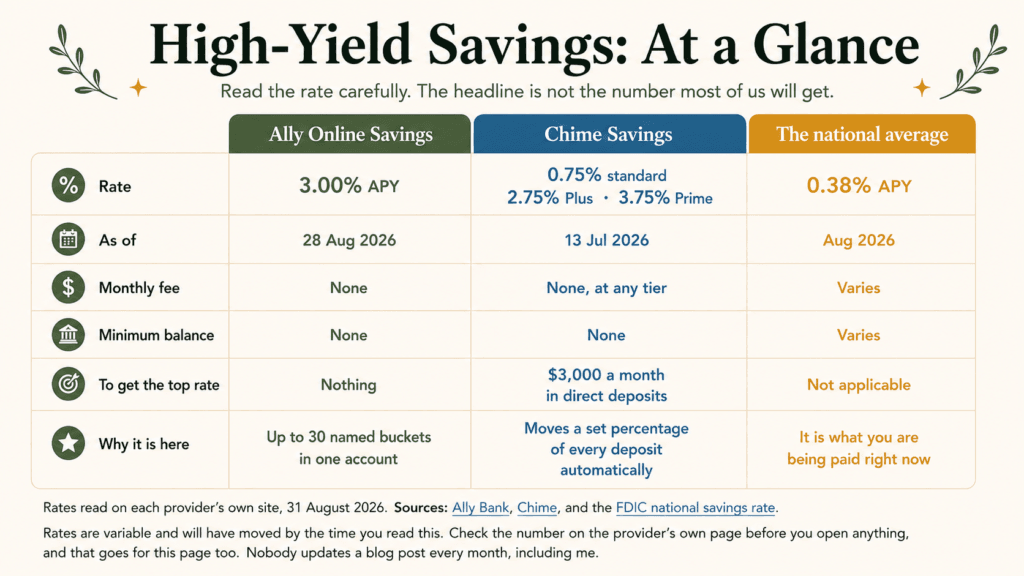
Rates are variable and will have moved by the time you read this. Check the number on the provider’s own page before you open anything, and that goes for this page too. Nobody updates a blog post every month, including me.
Whichever you open, check it is FDIC insured before you move a dollar into it. Thirty seconds, and the coverage limits and the rest of the argument, including how much friction is the right amount and whether to run one account or several, are in where to keep your savings challenge money.
How to know if you picked the right number
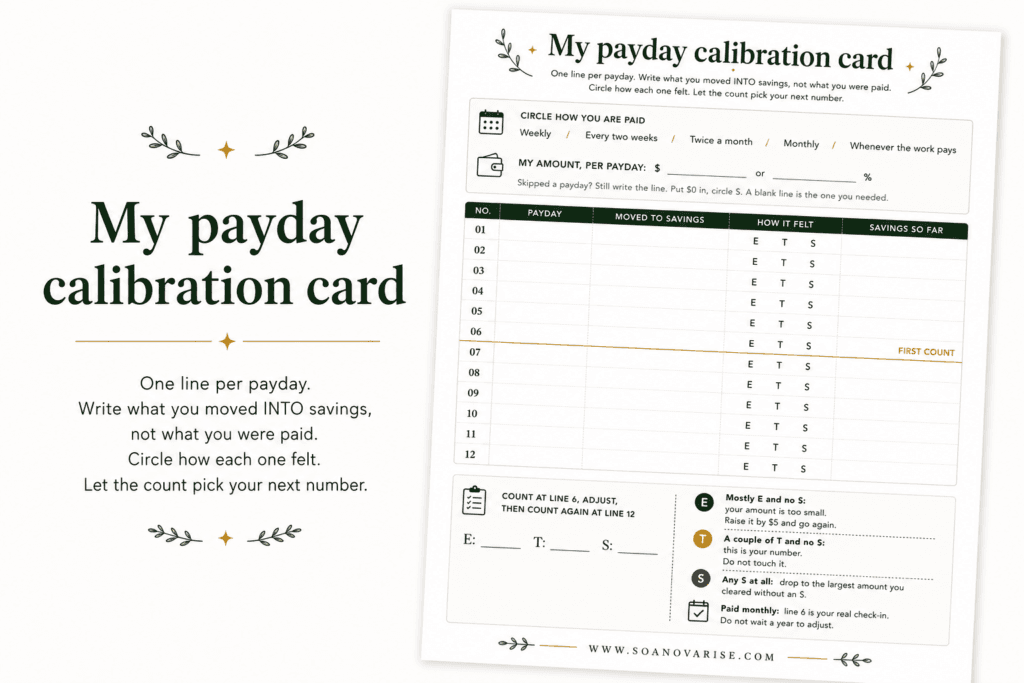
This is the part the trackers never do, and it is why the printable has that extra column.
Every tracker online records what you saved. None of them record what it cost you to save it, so you arrive at deposit twelve with a total and absolutely no idea whether you could have done more, or whether you very nearly did not make it at all.
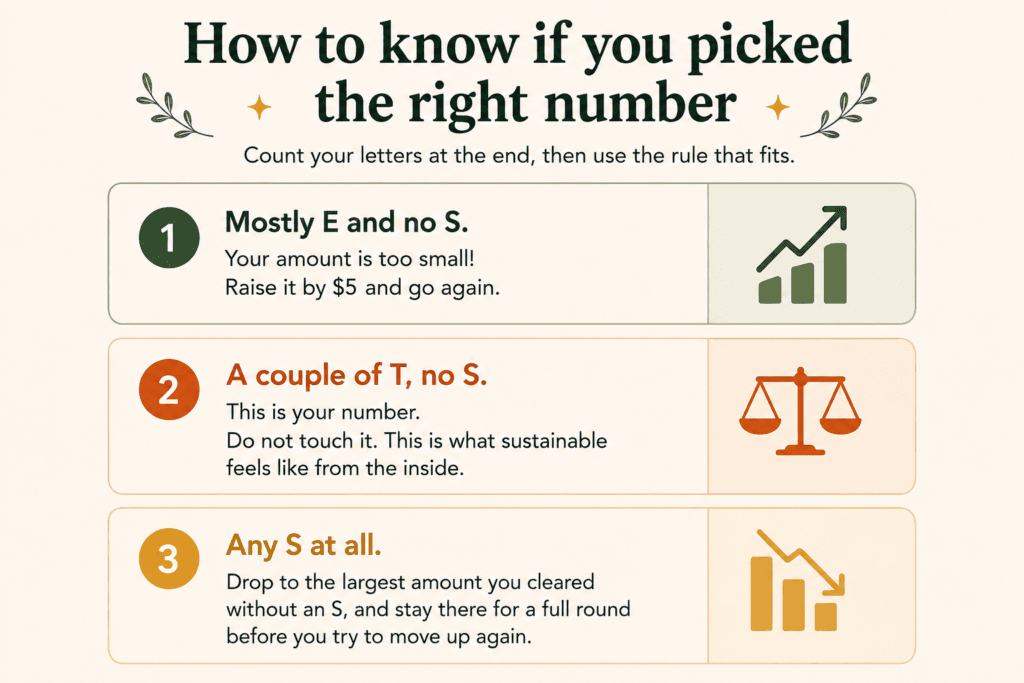
So on the calibration card, next to every deposit, there are three letters and you circle one on the day. E for easy, you barely noticed it go. T for tight, you made it but something else got squeezed. S for skipped.
Then you count them up, at line six and again at line twelve, and the page tells you the number to run next time:
- Mostly E and no S. Your amount is too small! Raise it by five dollars and go again.
- A couple of T, no S. This is your number. Do not touch it, this is what sustainable feels like from the inside, and it is supposed to feel like this.
- Any S at all. Drop to the largest amount you cleared without an S, and stay there for a full round before you try to move up again.
Line six is the one that matters if you are paid monthly, because twelve lines is a whole year for you, and finding out in December that you could have saved more is not really finding out. Everyone else can treat line six as a check-in and line twelve as the real answer.
And listen… some skips are just life happening on schedule, and a circled letter cannot tell the difference. My dad RETIRED. After all those years, and I was not about to hand that man a card and call it done. That gift came out of my savings and it took a proper chunk of it, and the tracker sat there recording a bad month, which was not what it was at all. So circle the S honestly, but when you count them at the end, you get to separate the ones where the amount was too high from the one where your father retired exactly once in his life.
You cannot know any of this in advance. Not from a budget, not from a calculator, and definitely not from how motivated you feel in the first week of January. You find it out one payday at a time, and twelve lines is enough to find it.
Getting started
Print the card, or draw twelve lines on the back of an envelope… it works exactly the same and nobody is checking!
- Find your row in the table and take that challenge.
- Pick an amount that feels slightly too easy. It is sustainable, and sustainable feels identical to too easy at the start.
- Open the account before payday, not on payday.
- Set the transfer for the morning you are paid, not the evening.
- Circle a letter every time. Count at line six, then again at line twelve.
And if you want a target rather than a whole year, saving $1,000 in three months is the same machinery pointed at a deadline, and the real emergency fund number is the honest answer to what you should be aiming at once this one is finished.
Your first challenge only has to end with you having finished something, whatever the number on the last line turns out to be. That is the bit that carries into next year. And the strange months are coming either way, so you may as well be running a plan that was built to survive one.