How to Save $1,000 in 3 Months (Even If You Feel Behind)
Three summers ago I had twelve weeks to find a security deposit and a first month’s rent, and I had neither. What I had was a checking account that sat at roughly the same low number no matter what I did, which is its own particular kind of tiring, because it starts to feel like the money leaves on its own and you are just the person it happens to.
I got there with four days to spare, but the thing that nearly wrecked it had nothing to do with the math, and it is the reason this page exists in the shape it does.
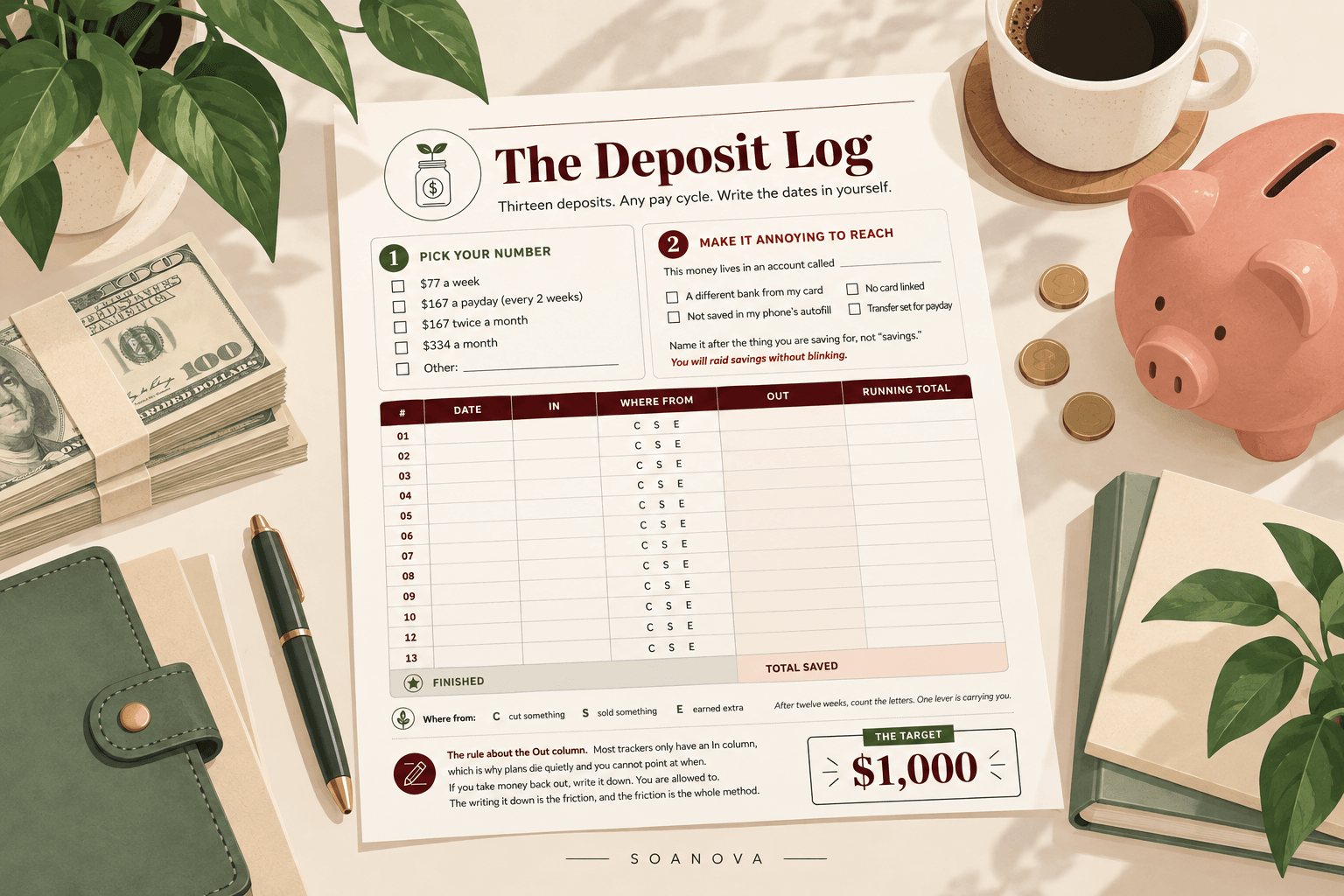
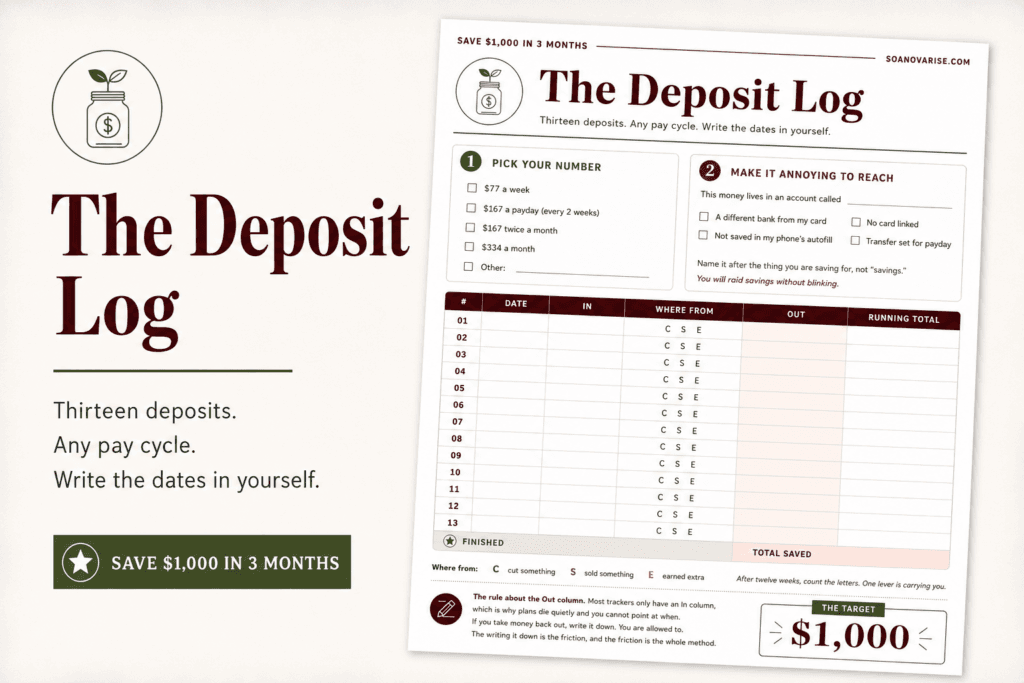
So I made you the thing I wish I’d had. One page, thirteen lines, no email, and two columns nobody else prints. The whole article below is just me walking you through it.
One number first, because it reframes the whole thing. Bankrate’s emergency savings report found that just 47 percent of Americans have sufficient liquidity or access to funds to cover a $1,000 emergency expense. Read the wording closely though. “Or access to funds” quietly includes a credit card, so the share who could pay it from money they already hold is smaller than 47 percent.
I was in the majority that couldn’t. Three months later I wasn’t. Here is the page, box by box.
Box 1: pick your number
Top left of the page, five check boxes. Check the one that matches how you get paid, not the one that sounds most impressive, and use the Other line if your pay is irregular.
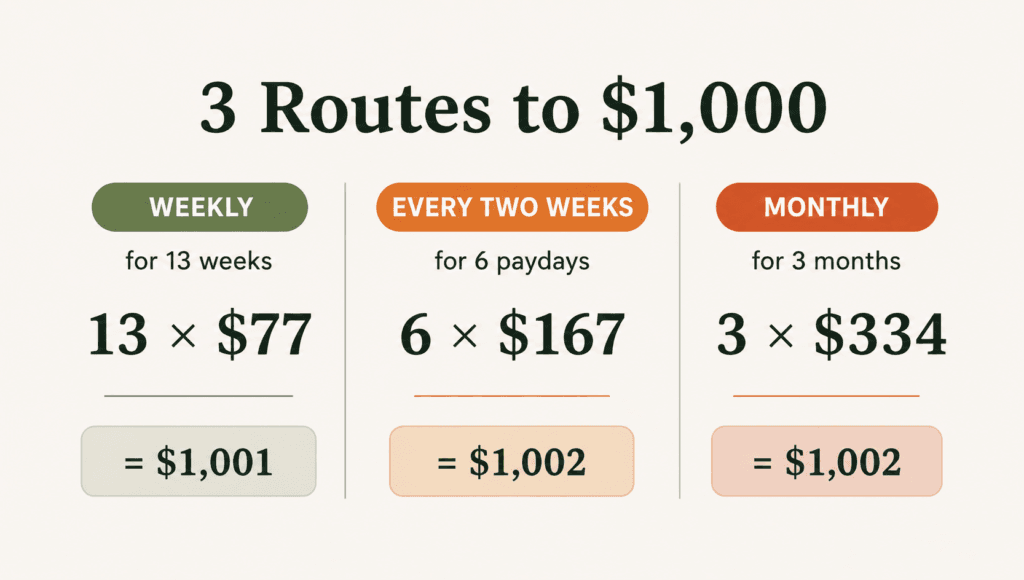
| If you save | You need | Which is roughly |
|---|---|---|
| Weekly, for 13 weeks | $77 a week | Two takeout dinners |
| Every two weeks, for 6 paydays | $167 a payday | One big grocery run |
| Twice a month, for 6 pay dates | $167 a pay date | Same, on the 15th and the 30th |
| Monthly, for 3 months | $334 a month | A car payment you don’t have |
This matters more than it looks, because if you’re paid weekly and you choose to save monthly you’re asking yourself to sit on three weeks of money before you move it, and money that sits gets spent. Save on the rhythm you’re paid on.
Box 2: make it annoying to reach
Top right of the page. It looks like admin. It is the box that saved my challenge.
Every article about saving a thousand dollars is about getting the money in. Cut this, sell that, pick up a shift. Fine, and I did all three of those, but no plan I have ever run has died on the way in.
Saving $1,000 is not an arithmetic problem. It’s a withdrawal problem.
Around week seven I nearly moved forty dollars out of the fund for a night out. Not a crisis. A Friday, a group chat, and the extremely reasonable-sounding thought that I’d put it back next week.
I would not have put it back next week. I know that about myself now. At the time I fully believed me.
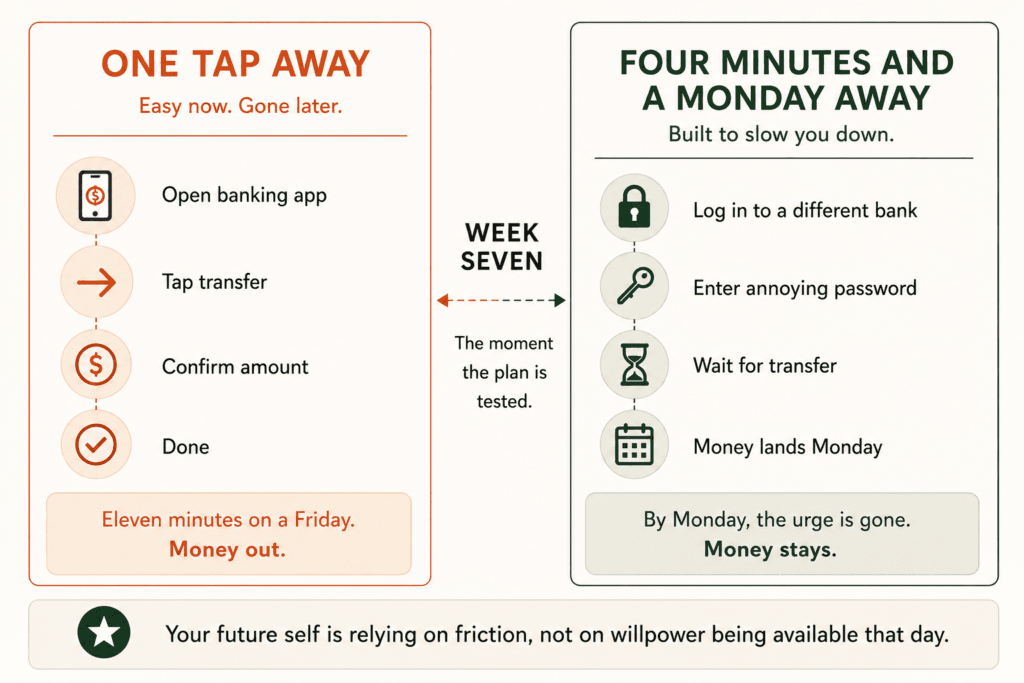
What saved it was not willpower. The money was in a different bank with no card attached, so getting at it meant logging into somewhere I never logged into, remembering a password I’d chosen specifically to be irritating, and then waiting on a transfer that would land Monday.
Not because my bank was slow, either. Transfers between two different banks run on a network that only settles on business days, so a Friday night request just sits there until Monday. That isn’t a flaw in the system. It’s the part I was using.
By Monday I didn’t want the forty dollars. I’d wanted it for about eleven minutes on a Friday, and eleven minutes is shorter than a bank transfer.
So box 2 is four check boxes and one blank line, and here is what each of them is quietly doing.
- A different bank from the one your card is attached to. Not a second account at the same bank. A different login.
- No debit card linked. If one exists, ask for it not to, or put it in a drawer at home.
- Not saved in your phone’s autofill. Yes, this is petty. Petty is the mechanism.
- The transfer set for payday itself, not a day you picked and can have feelings about later.
Those four aren’t random fussiness. They’re four exits, being closed. A different bank shuts off the instant internal transfer, the one that moves in seconds because the money never leaves the building. No card linked shuts off the instant push to a card. And a password you have to remember, on an account your phone won’t fill in for you, turns a decision into an errand.
But my bank moves money instantly, even on a Sunday! Some do now, yes, and more will. If yours is one of them then that particular door is already shut to you, so the friction has to come from the other three, and the naming one below does more work than people expect anyway.
And then the blank line, which is the one people leave empty and shouldn’t. Write what the account is called. Mine was called the deposit. You will raid something named “savings” without blinking, because savings is an abstraction and abstractions don’t argue back. You will feel strange raiding the deposit, or Portugal, or the car.
If your savings sits in the same app you buy things with, one tap from your card, then every time you’re tired or sad or it’s someone’s birthday you’re relying on being a better person than you were last time. Some weeks you will be! Thirteen weeks is a lot of weeks though.
On which account, I’ve written the longer version, including what an interest rate is genuinely worth on a few hundred dollars and the three things to check before you open anything, in where to keep savings challenge money. Short version: you’re not looking for the most convenient account. You’re looking for the least convenient one that still pays you something.
The thirteen lines, and why they’re lines and not weeks
The rows are numbered 01 to 13 and the date column is blank, which is deliberate. Every savings printable I could find is built for a weekly saver, and most people aren’t. The Bureau of Labor Statistics puts US private establishments at 43 percent biweekly, 27 percent weekly, 19.8 percent twice a month and 10.3 percent monthly, so biweekly is the biggest group and it still isn’t most people.
So the log doesn’t tell you when. You write the date on the line the morning the money moves. Thirteen deposits is thirteen deposits whether they land every Friday or on the 15th and the 30th.
Why thirteen and not four or fifty-two, while we’re here. Squeeze $1,000 into one month and it’s $333 a week, which for most beginner budgets isn’t a challenge, it’s a fantasy. Stretch it past six months and something quieter goes wrong: motivation doesn’t collapse, it just stops being interesting around week nine, and one skipped line becomes two, and then you’ve stopped without ever deciding to.
Thirteen lines is the length where you can see the end of it from the beginning.
The “where from” column: C, S or E
Every line has three letters to circle, C for cut something, S for sold something and E for earned extra, and it takes about a second but it turns the page into evidence.
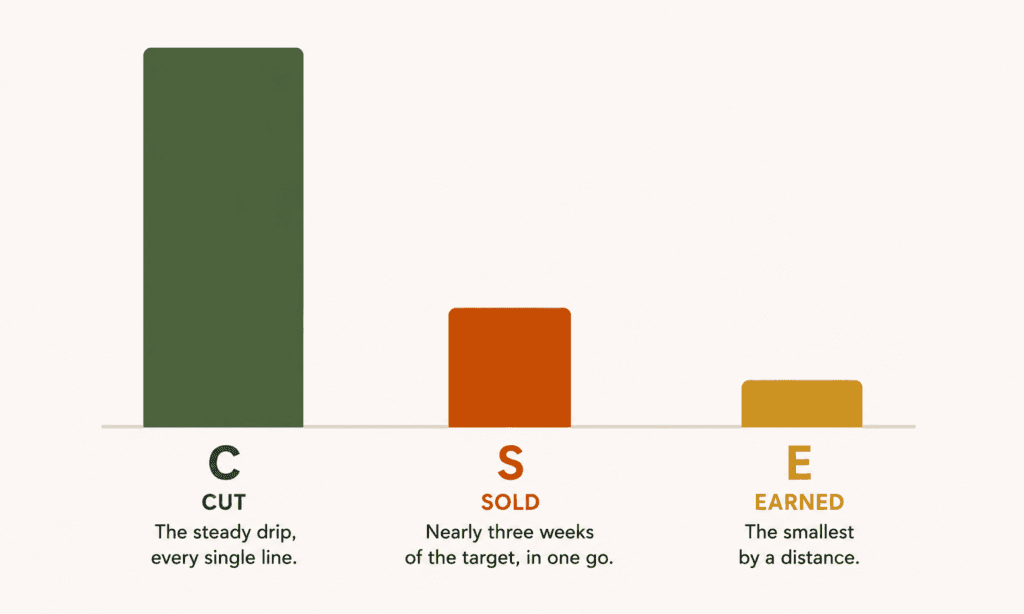
Because the three levers are wildly different sizes and almost nobody tells you which one is carrying them. Mine went like this.
| Letter | What it was, for me | What it was worth |
|---|---|---|
| C cut | Skincare I could do without, and things I was sure I needed first | The steady drip, every single line |
| S sold | One closet, two weekends, a local marketplace app | Nearly three weeks of the target, in one go |
| E earned | A few extra hours, picked up here and there | The smallest by a distance |
C: cut first, because it’s free
Before touching anything else I ran a real zero-based budget for one month, which is the only reason I found anything at all. And what I found was not what I expected to find.
Skincare, mostly. Not the things I was finishing, the extras. And sitting underneath the skincare was a pattern I could not see until it was written down in a column, which is that I kept buying things I was completely certain I NEEDED before I could get anywhere. The right serum. The right planner. The right bag for a job I had not applied for yet. Every one of them felt like momentum, and every one of them was money that did not make it to Friday.
This one is harder to cancel than a subscription, because there is no button. There is just a question you have to ask yourself on the checkout page, and the question is whether you want the thing, or whether you want to be the sort of person who owns the thing.
Those feel identical at 11pm.
None of that needed willpower to fix, in the end. It needed me to look, and I had been putting that off for months, because I had a rough idea of what I would find and I did not want to see it written down.
S: sell one closet, not the whole apartment
One closet, listed on a local marketplace app over two weekends, and it covered nearly three weeks of the target on its own.
The “one closet” part is the whole point. “Declutter your life” is how this advice usually arrives and it’s exactly why nobody does it: the whole apartment is a project, and projects are where good intentions go to sit down. One closet is an afternoon.
Worth saying plainly, because it surprised me: the fastest money I made in those twelve weeks was money I already owned.
E: earn a bit more, if your schedule has room
My smallest lever by a distance, a few extra hours here and there, and also the one I liked least and did least of. If you have the room it moves faster than cutting ever will. If you don’t, the challenge doesn’t fail without it. C and S got most of me there.
Circle the letters as you go and count them at the end, because one lever will be carrying you and I would bet money it isn’t the one you assumed when you started.
The “out” column, which is the whole reason I made this
Look at any savings tracker on the internet. Squares to color in, thermometers to fill, a running total climbing toward a goal, and every last one of them measures a single direction.
Mine has a column for the money you take back out, and I know it looks pessimistic. It isn’t. It’s the friction.
You are allowed to take money out. Life happens in twelve weeks, the car does a thing, someone gets married. The rule is only that you write it on the line, in the pink column, in your own handwriting, next to the letter that says how you earned it in the first place.
Why a pen and not an app. Writing it down takes about fifteen seconds, which is fifteen seconds longer than tapping “transfer” while you’re standing in line. That gap is the entire intervention.
And at the end of the thirteen lines you can see exactly where it went, instead of arriving at $740 with a vague feeling that you were bad at this.
Plans don’t usually fail loudly. They leak. The out column is where the leak becomes visible while there’s still time to do something about it.
But what if there isn’t $77 a week anywhere?
Then this isn’t your challenge yet, and that is information rather than a failure, so please don’t read it as one.
If there’s genuinely no spare $77 in the month once the essentials are paid, you don’t have a savings problem, you have a budget problem, and sprinting at a target your income can’t currently carry mostly teaches you that you can’t do it. Which isn’t true, and isn’t a useful thing to learn about yourself. Start with what a realistic emergency fund actually needs to be instead.
And if the money is there but the pace isn’t, take longer. The 52-week challenge lands somewhere similar over a full year with a much gentler weekly ask, and I’ve been honest about where that one goes wrong too. If you’re not sure which shape suits you, the five savings challenges matched to your paycheck sorts it out in about two minutes.
Pick the timeline that matches your real paycheck and your real patience. Nobody is grading the speed.
What to do this week
- Print the log. One page, normal paper.
- Tick your number in box 1: $77 a week, $167 a payday, or $334 a month.
- Open the account somewhere else. Different bank, no card, and write its name on the blank line in box 2.
- Set the automatic transfer for payday, before you’ve had a chance to have an opinion about it.
- Run one month of a zero-based budget and find your two leaks. Everyone has two.
- Give one afternoon to one closet. Not the apartment. The closet.
- Put the page where you’ll see it on payday, and fill in line 01.
That’s the whole method, and it took me twelve weeks and one very close call.
I made the deposit with four days to spare, and honestly? The saving part turned out to be boring, which was the surprise. I’d spent years assuming a thousand dollars was something that happened to organized people with better instincts than mine, and it turned out to be thirteen lines on a page and one account I couldn’t easily get into. You don’t have to become someone else first. You just have to make it slightly annoying to change your mind.